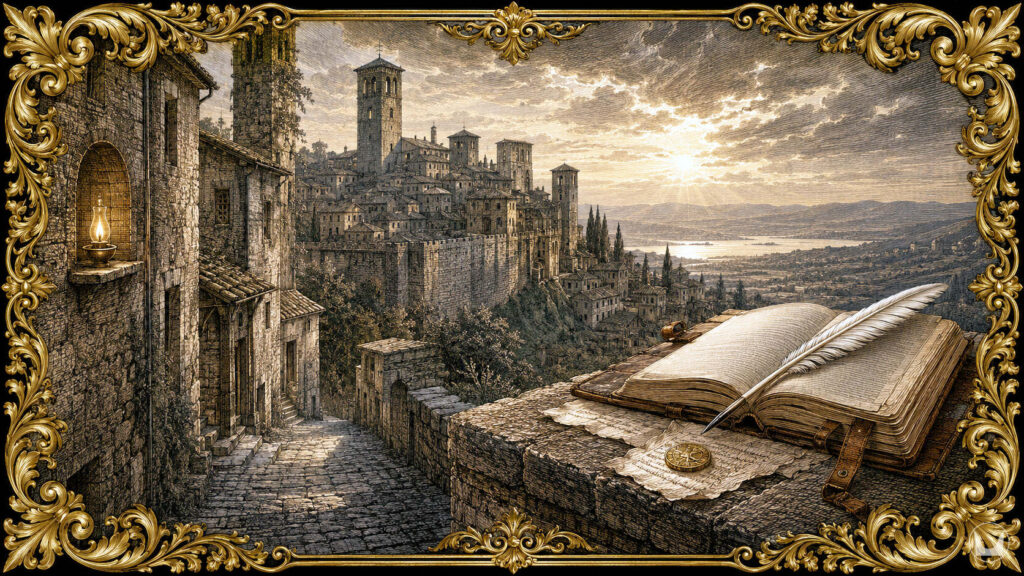
There is a difference between visiting a place and being taught by it. Tourism gives you impressions. Fieldwork—the kind that involves returning in different seasons, taking measurements, sitting alone in churches until the silence becomes uncomfortable—gives you something harder to name and more difficult to acquire: an understanding of how a place works upon a person. Not its postcard face, but its grain.
I have been to Cortona three times. I will go again. Each visit has added something to my understanding of what it means to render a place in fiction, not merely to describe it but to make a reader feel they have been there without knowing they have. What follows are five things those visits taught me about the craft of writing sense of place. These apply to Cortona and also to Florence, Knossos, Mycenae, and every location I have stood in and afterward tried to resurrect in prose.
 I. The Body Knows Before the Mind Does
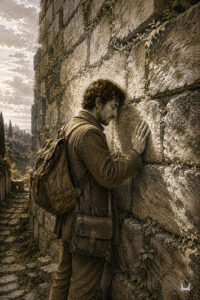
On my first visit to Cortona, before I had seen the museum or eaten the pici al ragù di cinghiale, I walked to a section of the Etruscan wall and touched it. My hand was on the stone before the thought had fully formed, as though something in me recognized the place before my conscious mind caught up.
This is the first thing Cortona taught me: when writing sense of place, physical sensation precedes and outranks intellectual description. The body’s response to the need to touch a surface, the impulse to leave a room, the way the light seems to change in a particular setting, is the primary material. The meaning may follow, or it may not. A reader does not need to be told the significance of a place. They need to feel what it does to the body of the character who inhabits it.
In my fiction I always begin with the physical world. What does the stone feel like under the hand? What does the air smell of in this corner of this courtyard at this hour? These are not decorative questions. They are the questions that determine whether the reader experiences what is on the page as real.
 II. Discomfort Is Data
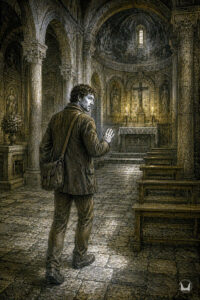
The Church of San Francesco unsettled me. I felt watched at the front altar. I did not linger inside. I needed air. Another writer might have suppressed that response in favor of admiring the architecture, noting the dimensions of the nave, recording the dates of construction. Instead, I wrote: Feeling watched. Must leave.
Via Ghibellina disturbed me further: the light faded; a voice I could not account for resounded; a series of images I had not summoned flashed past. I walked back to the main piazza and left the city. A hard fall twisted my ankle on the road down to Camucia.
This craft lesson took me time to understand. The places that unsettle you are the places that will unsettle your reader. Fictional atmosphere is not built from beauty alone; it is built from the tension between attraction and unease. Cortona gave me both, and I learned to treat the discomfort not as an inconvenience to be managed but as information to be transcribed. The novelist’s notebook should record what the body wanted to flee, not only what the eye wished to linger over.
 III. Return, and Return Again
One visit gives you impressions. Five days give you rhythms.
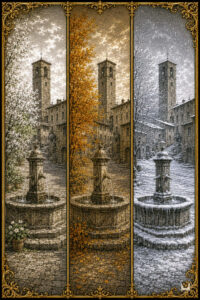
I went to Cortona in April, in October, and in January. Three seasons, three different encounters with the same streets, the same stones, the same views over the valley toward Lake Trasimeno. The April visit was luminous, disquieting, unforgettable. The October visit gave me the town at its ordinary pace—the morning routines, the quality of the afternoon light in the streets, the way Piazza della Repubblica sounds at different hours when the tourists have thinned. January gave me the cold, the emptiness, the place stripped of all performance.
A fictional character who lives in a place does not experience it as a visitor does. They know its moods. They know which hours are theirs and which belong to other people. They know how it smells after rain and how the stone changes color in the cold. A writer cannot render that without having felt the place across more than a single encounter. At best, the single research trip produces an impressionist sketch. Return visits produce inhabitation. And it is inhabitation that the reader feels when they turn the page.
 IV. Measurements and Photographs Are Not Enough
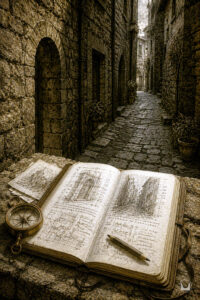
On my October visit I documented everything: I took measurements, photographs, notes on materials and proportions, records of what stood where and how far one place lay from another. This documentary discipline is non-negotiable for historical fiction. The writer who invents distances and arrangements will eventually be caught out by the reader who has been there.
And yet. The things that most animate my Cortona prose are not in any photograph. The voice on Via Ghibellina is not documented anywhere but in my journal. The quality of being alone on that street, the fading of the light and the sensation of being addressed by something that had been waiting, could not be measured.
The craft lesson is this: the documentary record is the skeleton. It keeps the fiction accurate and gives the imagination something solid to work from, or occasionally to depart from with intention. Without the measurements, the invented details drift into the implausible; yet without the invented details, the measurements produce reportage rather than fiction. The novelist needs both: the precision of the researcher and the receptivity of someone who keeps the notebook open for what cannot be photographed.
 V. Let the Place Tell You What the Story Is
I did not go to Cortona knowing I would write A Tale of Paris & Paris: Echoes of Troy. I went because Cortona had been in my thoughts for decades. I went because I could no longer not go.
The novel emerged afterward: from the journal entry written the night of that first disquieting visit, from the obsession that refused to resolve itself, from the accumulation of three visits across three seasons until the place had given me enough to begin. Four years passed between my first visit and the first page of the novel. I did not experience those four years as waiting. I experienced them as listening.
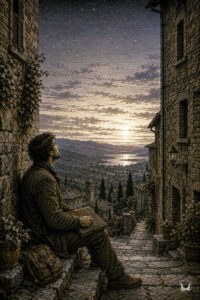
This is perhaps the most important thing Cortona taught me, and the hardest to teach in turn: the writer who arrives at a location with the story already fixed will find only confirmation of what they already believed. The place becomes a backdrop: serviceable, accurate, but ultimately inert. The writer who arrives open, and patient enough to return, and honest enough to record what disturbs as well as what delights, will find something else: the story the place has been holding in reserve, waiting for someone willing to sit still long enough to receive it.
Cortona was holding a story about belonging and loss, about souls who find each other across lifetimes, about a street that speaks in the afternoon when the light fades and the tourists are nowhere near. It gave me that story when I was ready for it. I suspect it is holding others still.

Rio de Janeiro, the ix day of June, MMXXVI


Click the cover to read a preview chapter and learn more.