There is a sentence men have told women for as long as sentences have been spoken: “Here is what you are for.” A daughter is for marrying well. A wife is for bearing sons. A queen is for outliving her usefulness with grace. A princess is for the alliance her body can purchase. None are permitted to refuse.
My women refuse anyway.
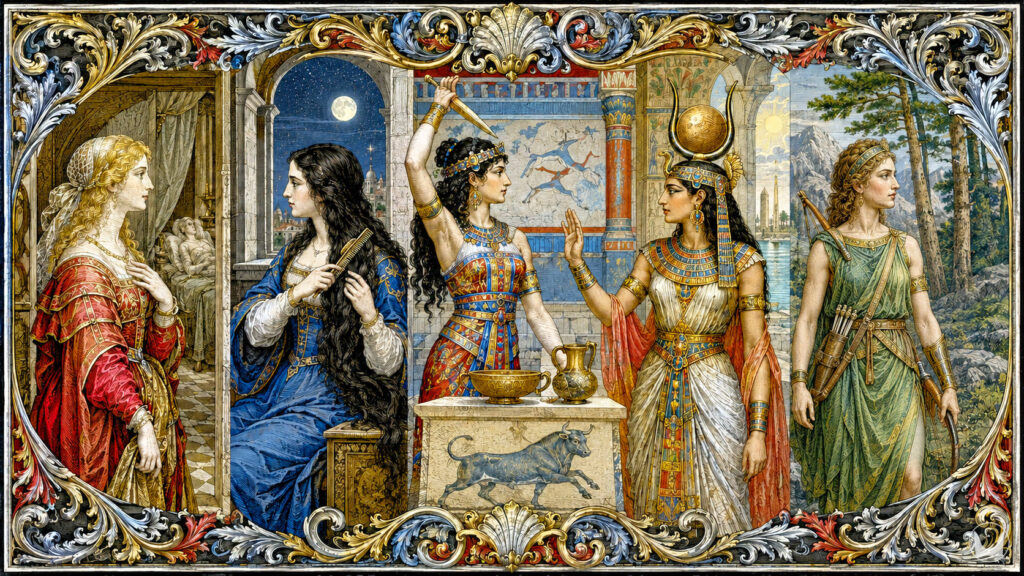
I did not set out to write five heroines and call it a thesis. I set out to write Costanza, then Elena, Pasiphaë, Meritamen, and Atalanta, never thinking of them as a chorus. It was only in stepping back that I saw what they had in common—not a shared circumstance, for their circumstances could not be more different, but a shared refusal to let circumstance write the final draft of who they are. This essay is an attempt to explain that refusal, character by character, and to say something true about why I write women the way I do.
What “Authentic” Does Not Mean
Before Costanza, before any of them, I want to clear away a misunderstanding I encounter often: the notion that writing a strong female character means giving a woman the psychology of a man and dressing her in skirts. I find this a failure of imagination. A woman who solves every problem by force, feels no fear, and wants nothing she cannot seize at once, is not a liberated woman. She is a man in costume, and costumes do not survive close reading.
The women I have known in my life—and I have known many remarkable ones—are not simple. They calculate. They love against their own better judgment. They perform deference while withholding their agency. They grieve in rooms where no one is watching and compose themselves before anyone enters. Their power is seldom the power to strike; it is more often the power to endure, to wait, to choose the moment, to know what they want and what it will cost to get it. Across three novels now I have given my women that complexity rather than its substitute.
 Costanza
Costanza’s whole refusal is contained in a single line spoken in Lorenzo’s sickroom. ‘Her destiny is bound to him. She ne shall suffer to be cloistered, for her bliss shall come to pass.’ The Church has one future for an unmarried maiden in the Quattrocento: the convent. Costanza refuses to accept it as inevitable, and she organizes her interior life around a different outcome, one she has wanted since childhood and has never allowed circumstance to talk her out of.
What I find authentically female in Costanza is the quietness of her refusal. Throughout the novel, she does not announce her defiance to anyone. She speaks in the language of devotion rather than rebellion, and yet underneath every gesture of caring is a will of iron. “I have lived for the covenant of kindred with you.” That is not a woman waiting for a man to choose her; it is a woman who chose, years ago, and waits for the world to catch up to her decision.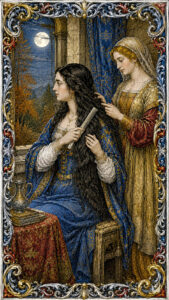
Elena
She is a noblewoman in a fifteenth-century household, pregnant for the third time by a husband she does not love and whose touch she experiences as wrongness rather than intimacy. There is no door out of this marriage that her century will open for her. Her refusal takes the only shape available to a woman with no exit: inward, without illusion.
What strikes me most when I reread the chapter where she combs her hair by the window is how unsentimental she is. She does not romanticize her trap. She names it with precision: “a cow would I be.” She questions her ignorance about her body with a frankness that has nothing to do with self-pity and everything to do with intellectual hunger, asking her companions and her mother, finding only silence, and concluding that women are kept unlearned on purpose. Then, in the same scene, she pivots: she teaches Margherita how to wash and care for her hair, she defends the murdered healers as women persecuted for embodying independence rather than witchcraft, and she resolves to seek out Milena the Ancient for a remedy no one else will name aloud. This is a woman managing five contradictory realities in a single evening—desire, fury, tenderness, fear, and resolve—without my needing to flatten her into either victim or rebel. She is both because that is what authentic female interiority under constraint looks like.

I place these two together since their refusal makes sense in opposition to one another. Pasiphaë has spent a lifetime in service to her kin, yet now as a widow, she has decided to claim something for her sake alone. But when Naia, her maiden spy, brings word that Meritamen, Asterios’s queen consort, schemes to displace her, Pasiphaë‘s response is not to wring her hands. She draws a dagger across her own palm and addresses her divine father in heaven. “None shall usurp the glorious legacy I have built for my children. Be it through sorcery, poison, or force, I shall prevail.” Minos may have worn the crown, but it has always been Pasiphaë who treats the kingdom’s future as hers to defend by any means.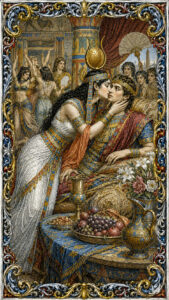
Meritamen is the character I wrote to resist easy reading on purpose. At the betrothal feast she kisses Asterios with a boldness that stuns the entire court into silence. Is this passion calculation, or the opening move of a longer game? I want the reader uncertain. Meritamen‘s true nature is the engine of the next novel in this series, and a woman who exists only to be unmasked later must be vibrant now, not as a placeholder villain. Her ambiguity is the refusal. She will not be reduced, this early, to either devoted bride or scheming antagonist. Just as Pasiphaë has to wait, the reader has to wait to find out what kind of queen Meritamen intends to become.
In some ways, Atalanta is the purest expression of this essay’s argument. The world has done much to her before the story allows her a choice. Her father exposed her on a mountainside as an infant for the crime of being born  female. Yet when he appears to beg forgiveness, what I wanted on the page was not a daughter overwhelmed by him, but a daughter evaluating him. She paces. She questions: “What would you have of me?” She decides, in real time and on her terms, that he is not the man she had thought, and chooses reconciliation not because convention demands it but because her judgment permits it. Even the small moment with her bow—insisting Néos bind it low against her back so her father’s warriors will not see it, then unwrapping that same bow in an instant to cut down nine bandits without hesitation—captures the whole of her: a woman who will perform what a situation requires while never surrendering what she is underneath the performance.
That in the end she loses everything to a cruelty of fate she did nothing to invite is a separate matter from her agency, and it matters to make that distinction explicit. With the single exception of the footrace, where Hippomenes wins by deception, every major turn in Atalanta‘s life is a turn she chose. Tragedy that befalls a woman who has spent the whole story choosing for herself is a different and more honest kind than what befalls a woman who was never granted the choosing in the first place.
What the Refusal Is For
None of these women refuse the same story. Costanza declines the convent. Elena resists erasure inside an unbreakable marriage. Pasiphaë rejects a foreign priestess’s rule over her line. Meritamen eludes legibility. Atalanta concedes nothing of who she is. What unites them is not a single act of defiance but a consistent interior sovereignty: beneath whatever the world has decided to do, each woman remains the final author of her own meaning.
That is the only definition of an authentically written woman I trust: not a woman who wins, not a woman who is invulnerable, but a woman whose inner life cannot be colonized by the plot the world has assigned her. I have seen it in women I have known and rendered it on the page.

Rio de Janeiro, the xx day of June, MMXXVI




Click any cover to read a preview chapter and learn more.