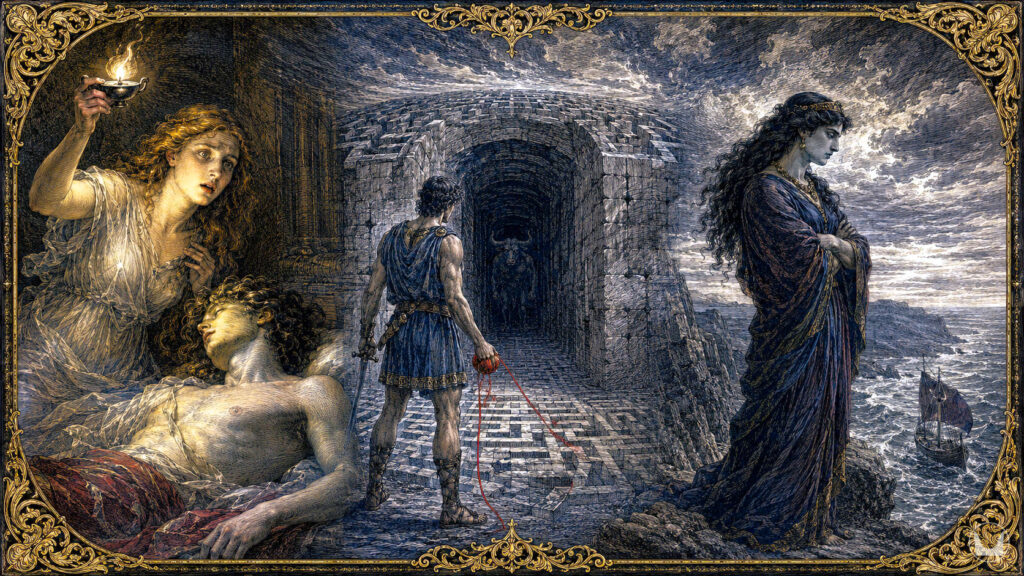
I confess that as a child I believed the following tales were the stories of real people who had lived long ago. Only when I got older did I understand their significance as myths, though at times I am not entirely sure. The details seem too specific, too human, too particular to be pure invention. Perhaps these people lived after all, and what we call mythology is simply the record that survived. Here are three that have accompanied me from youth to the present day and show no sign of leaving.
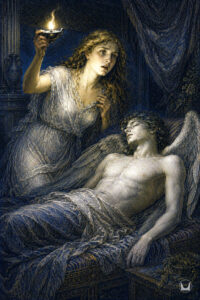
This is one of the most beautiful love stories the ancient world produced. It is preserved in The Golden Ass by Apuleius and tells of Psyche, a mortal princess whose beauty becomes so celebrated that it provokes the jealousy of Aphrodite. The goddess orders her son Eros to punish Psyche, to make her fall in love with something unworthy, but he falls in love with her instead and secretly becomes her husband, visiting her only at night and forbidding her ever to look upon him. Persuaded by her jealous sisters that he must be a monster, Psyche lights a lamp while he sleeps and discovers that the creature beside her is the most beautiful being she has ever seen: the god of love himself. Feeling betrayed, Eros abandons her.
To win him back, Psyche endures a series of seemingly impossible trials imposed by Aphrodite: sorting vast heaps of grain before dawn, gathering golden wool from murderous rams, descending to the Underworld to retrieve a casket of beauty from Persephone. She nearly perishes on that final task. Eros rescues her, pleads her case before Zeus, and Zeus grants Psyche immortality. The lovers are reunited, and the soul—for that is what Psyche means in Greek—has earned her place among the gods through suffering and endurance.
The story has long been read as an allegory of the soul’s journey through trial, transformation, and divine love. To me, the moral is simpler and more ruthless: true love cannot abide suspicion. The moment Psyche lifts the lamp, everything changes. She was warned. She chose to look anyway. I understand her completely.
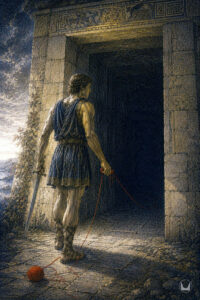
The myth of Theseus tells the story of Athens’ greatest hero, celebrated for courage, intelligence, and his role as the unifier of Attica. Born to Aegeus, though sometimes said to be the son of Poseidon as well, Theseus proved his royal identity by lifting a great stone beneath which his father had hidden a sword and sandals. Traveling to Athens, he defeated a series of notorious bandits along the road, establishing himself as a civilizing hero before he even reached the city. His most famous adventure took him to Crete, where Athens was forced to send youths as tribute to be devoured by the monstrous Minotaur. With the aid of Ariadne and her famous thread, Theseus entered the Labyrinth, slew the beast, and escaped.
On his return voyage, he forgot to replace his ship’s black sails with white. Watching from the cliff, his father Aegeus saw the black sails and believed his son dead. He threw himself into the sea that has borne his name ever since.
Later traditions give Theseus further adventures: his deep friendship with Pirithous of Larissa and his participation in the hunt of the Calydonian Boar. Both Theseus and Pirithous appear in Atalanta of the Wild, which covers that hunt as Ovid recounted it. I have spent considerable time in his company and cannot say that I am fond of him. I will never forgive him for abandoning Ariadne on Naxos—though I am glad that because of it she found a superior husband.
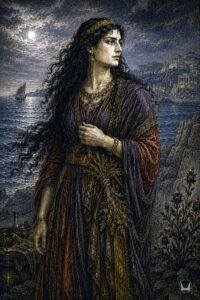
By the age of ten I had read about the Argonauts and their quest for the Golden Fleece. My steadfast Madrinha Ionyr, who never let me be without a book, gave it to me. The tale fascinated me as much as the labors of Herakles, the story of Perseus and Medusa, and Theseus in the Labyrinth. Medea and Jason made a lasting impression from the start: the sorceress princess of Colchis who betrayed her father and her homeland for love of a Greek adventurer, who helped Jason win the Fleece and flee, who killed her own brother to slow the pursuit. A woman who gave everything.
It was not until my mid-teens that Euripides‘s Medea got her to haunt me. The play does not soften her. It gives her instead the most devastating dramatic logic in all of Greek tragedy: a woman abandoned by the man for whom she destroyed her world, who chooses a revenge so complete that it consumes her own children. Euripides makes you understand her without permitting you to excuse her. Few things in drama are harder to achieve.
In Atalanta of the Wild, Jason appears in the chapters covering the Calydonian Boar hunt; Medea‘s name surfaces a few times, as if demanding attention. I plan to return to her this coming autumn—my next novel is hers. If anyone understands Medea, I do. She and I share the same hopes and the same fears. I think of us as kindred spirits who can still love each other beneath our dreadful façades.
Some monsters are born. Others are made.

Rio de Janeiro, the iii day of June, MMXXVI.


Click the cover to read a preview chapter and learn more.