This is a fascinating question precisely because it touches the murky frontier between Mycenaean religion, Arcadian local cults, and the Olympian mythology that the Greeks of the Archaic and later periods projected backward into the Bronze Age. The short answer is that Athána Alēa is not an Olympian Athena at all. She appears to preserve traces of a much older Arcadian goddess whose identity was merged with Athena after the rise of the Olympian pantheon. The longer answer is more interesting.
 The Sanctuary at Tegéa
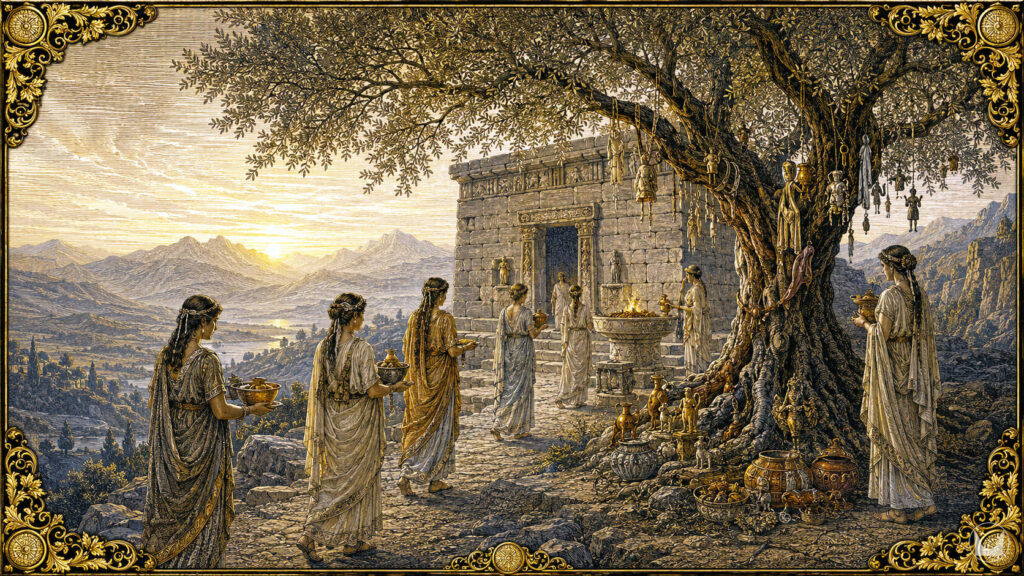
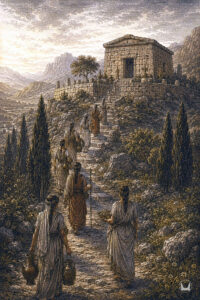
In classical Arcadia, the most famous sanctuary of Athána Alēa stood at Tegéa. In Atalanta of the Wild, Lord Iásios—Atalanta‘s father and wanax of the town—worships her. So doAtalanta‘s younger brother and sisters. Several scenes are devoted to the goddess’s temple, the procession leading to it, and the sacrifices offered at her altar. In a chapter near the novel’s end, Athána herself speaks to them, possessing one of her priestesses to do so. Throughout the novel she is a source of wisdom, protection, and fertility for the land, not a distant Olympian figure but an immediate presence.
The epithet Alēa is peculiar because it is not transparently Greek. Ancient writers were uncertain about its origin. Some ancient commentators explained it as the name of a local hero or king; others as a title of Athena; others still as the name of an older deity absorbed into Athena‘s cult. Modern scholars tend to find the last possibility the most compelling. The name Alēa may preserve the memory of an indigenous Arcadian goddess who predated Athena‘s dominance in the region.
 Arcadia and Religious Conservatism
The central Peloponnesian region was famous in antiquity for preserving ancient traditions. Even Classical Greek authors viewed Arcadians as custodians of cults that elsewhere had been smoothed away by centuries of pan-Hellenic standardization. The mountainous geography was partly responsible: less exposed than coastal regions to successive waves of political and cultural change, Arcadia retained what other places forgot. Many Arcadian deities possess unusual local forms—Déspoína, Dēmētēr Melaína, Pan—that do not fit well within the tidy genealogies of Olympian theology. Athána Alēa belongs comfortably within this landscape of localized, archaic divinities.
 Was Athena Present in the Bronze Age?
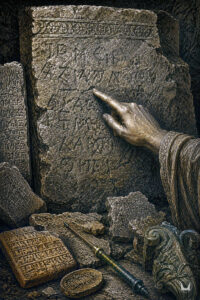
Yes, though perhaps not in the form familiar from Homer. The Linear B tablets of Mycenaean Greece contain what appears to be an early form of her name: a-ta-na-po-ti-ni-ja, usually interpreted as Athána Potnia, which means Lady Athána or Mistress Athena. This is an extraordinary piece of evidence. It establishes that a goddess called Athána already existed during the Mycenaean period, centuries before the Iliad was composed.
The title Potnia—Mistress or Lady—was widely used for powerful Bronze Age goddesses. Many scholars believe that Athena began as one of these Great Lady figures before accumulating the characteristics of the fully developed Olympian goddess.
 Athena Before Zeus
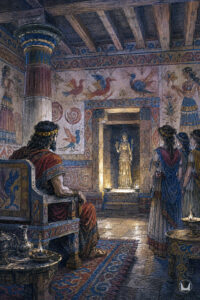
The Athena familiar from classical tradition is the daughter of Zeus, goddess of wisdom, patroness of heroes, defender of cities. But many scholars suspect these attributes accumulated gradually. In the Bronze Age she may have been something closer to a manifestation of an older mother-goddess tradition, a palace goddess, a guardian of rulers. The Linear B evidence does not show Athena as Zeus‘s daughter. In fact, Zeus appears far less dominant in Mycenaean religion than in the coming centuries. This suggests that Athena‘s filial relationship with Zeus may have developed only after the collapse of the Bronze Age palace system.
 Could Alēa Be Older Than Athena?
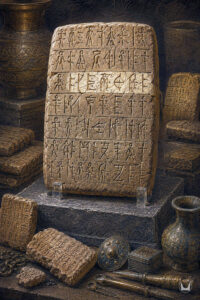
Possibly. One influential theory proposes that Arcadia possessed a local goddess named Alēa; that Mycenaean and later Greek populations worshipped Athena; that the two figures became identified over time; and that the resulting composite deity became Athána Alēa. Such mergers were common throughout Greek religion. Local nymphs became Ártemis; local mother goddesses became Dēmētēr; local sky gods became Zeus. Greek religion was remarkably adept at absorbing older cults rather than erasing them. What survives in the epithet Alēa may be the ghost of something that once stood on its own.
 The Bronze Age Goddess
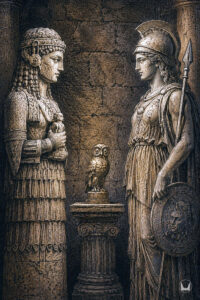
During the Late Bronze Age in Arcadia, Athána Alēa might best be imagined not as the armored virgin of the Parthenon but as a powerful local Lady: protectress of hilltop settlements, guardian of rulers and warriors, patroness of craftsmanship, associated with sacred animals and the fertility of the surrounding land, possessing chthonic aspects that Olympian theology would minimize or erase. She would stand closer to a Minoan-Mycenaean Potnia than to the rationalized Athena of classical Athens.
No text describes Bronze Age Athána Alēa directly. What we know of her is informed speculation. A worshipper in Arcadia around 1300 BCE might not have recognized the theological distinctions between Athena, Alēa, and Potnia. They may have spoken simply of the Lady, a goddess who protected the settlement and its flocks, its warriors, its rulers, and the fertility of the land around it. Only with the passage of centuries would poets and 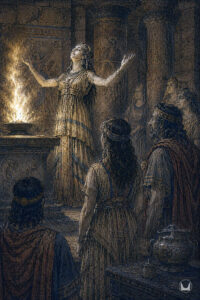 priests reinterpret that ancient Lady as the daughter of Zeus.
The Novelist’s Athána
As a novelist writing Bronze Age Arcadia, I imagined Athána Alēa less as an Olympian goddess than as one of the local faces of the Great Goddess tradition that once permeated the Aegean. This ambiguity is what makes her so compelling to write—and, I hope, to encounter. In Atalanta of the Wild, she stands at the crossroads between the Minoan and Mycenaean Potniae and the Homeric gods: a relic of a religious landscape older than Olympus, still capable of possessing a priestess and speaking through her mouth.

Rio de Janeiro, the iii day of June, MMXXVI.


Click the cover to read a preview chapter and learn more.