There is a sentence I keep returning to when I think about how to write the ancient world: a writer must disappear into it, not explain it from the outside. Mary Renault understood this better than almost anyone who has written historical fiction in English, and most novelists who have come after her, myself included, are still working in the territory she opened.
 This essay is about what she did, why it matters, and what it means to me.
A Voice From Inside Oppression
Mary Renault began her career writing contemporary novels, several of them dealing with same-sex attraction at a time when such subject matter was dangerous. Purposes of Love, her first novel, was published in 1939. In 1947, her novel Return to Night won an MGM prize, and the money it brought allowed her and her partner, Julie Mullard, to leave Britain for South Africa in 1948. There, away from the censorship and the criminal statutes of postwar Britain, she found the freedom to write the books for which she is remembered: The Last of the Wine, The King Must Die, The Bull from the Sea, The Persian Boy, Fire from Heaven, and others.
It is worth talking about what Britain was in those years for a writer like Renault. Homosexuality remained a criminal offense. Men were imprisoned by the thousands. Some, like Alan Turing, the codebreaker whose work shortened the Second World War, were subjected to chemical castration as a condition of avoiding prison, a punishment that contributed to his death by suicide in 1954. This was the world Renault left behind through her writing.
 I find it difficult to grasp how she managed it, to produce work of the quality of The Persian Boy or The Bull from the Sea, novels now regarded as among the finest historical fiction in English, while living under laws designed to criminalize who she was. I work in her tradition, but I do not work under her constraints. In Brazil, where I live, the rights of LGBTQ+ people are protected by law. That is not true everywhere. In Iran, Saudi Arabia, Yemen, Uganda, Nigeria, and other countries, homosexuality remains punishable by death. Renault‘s achievement was not only literary. It was an act of survival that became art.
The Refusal to Explain
Here is the thing Renault did that most historical novelists still do not do, and it is the craft principle I have taken from her: she refused to explain the ancient world in modern terms.
Her characters do not pause to comment on how strange their customs would seem to us. They do not editorialize about their beliefs as though aware that a twentieth-century reader is looking over their shoulder. A character in The King Must Die does not think like a person who has read Freud, even though Renault likely had. The gods are real to her characters because the gods were real to the people of that world, and she commits to that reality without winking at the reader.
 This is harder than it sounds. The temptation for any historical novelist is to build a bridge—to have a character notice something “modern” readers will relate to, or to frame an ancient custom in a way that reassures them they are not as different from us as they might seem. Renault never builds that bridge. She trusts the reader to cross unassisted into a world that operates on its own terms.
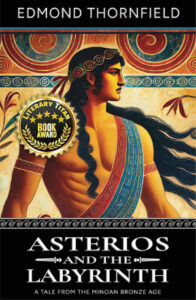
I have followed her example in every novel I have written. My characters in Asterios and the Labyrinth, moving through Bronze Age Knossos, do not think like people from any century but theirs. The same is true of the Florentines in A Tale of Paris & Paris: Echoes of Troy, and of the Mycenaeans and nymphs of Atalanta of the Wild. None know they are in a historical novel; none are performing the past for an audience. They are living it, and the reader is permitted to live it with them.
Where Renault and I part ways is in register. She wrote in clean, modern English prose, elegant and precise, with no archaism at all. I have gone the other direction, reaching back into Middle English and Early Modern English to give my narrators a voice that feels excavated rather than written. But the underlying commitment is the same: neither of us produces what I think of as costume drama, characters in period dress mouthing modern sensibilities. The difference between her prose and mine is a difference of surface. The commitment to a world that does not know it is being observed is identical.
Living From the Inside Out
The second thing Renault did better than almost anyone was interiority. Her characters are not types or symbols. They are complicated minds, often contradictory, capable of self-deception and sudden clarity. We do not watch Alexander or Theseus or Bagoas from the outside. We are inside them. We hear what they tell themselves, including the things they get wrong. We feel what they feel.
This is the harder half of what Renault accomplished because it is invisible when done well. A reader does not notice interiority the way they notice a vivid description of a battle or a temple. Partway through a chapter, they find that they have stopped reading about a character and started thinking as one. That seamless transition is one of the most difficult things a novelist can do.
It is also the lesson I return to when I am working. In Atalanta of the Wild, the narrator Néos does not just describe events from a distance; the reader must feel the weight of what he chooses to tell or withhold. In A Tale of Paris & Paris, with its many points of view, each character’s scene has to feel like a different mind, not the same authorial voice wearing different costumes. Whether I have succeeded at this to the degree Renault did, I cannot say. But I know it is the standard, and I know where I learned to aim for it.
 What Most Historical Novelists Still Miss
I do not think either of these things, the refusal to explain and the commitment to genuine interiority, is a matter of talent alone. They are choices that go against the grain of what is easiest to write and sell. It is easier to have a character notice something “timeless” for the reader’s sake. It is easier to describe a character’s feelings from outside than to construct the experience of having them.
Mary Renault made the harder choices across a body of work that spans decades, continents, and an extraordinary range of historical settings. She lived a life that the world she was writing in did not permit her to lead openly. That she did this work, and did it this well, under those conditions, is the reason she remains a source of inspiration to me.

Rio de Janeiro, the xv day of June, MMXXVI.



Click any cover to read a preview chapter and learn more.