 Early in Atalanta of the Wild, there is a moment where her father’s warriors lead her out of the Arcadian mountains and onto open ground, and the prose names it plainly: “the golden fields of fertile Tegéa.” I did not plan that sentence as a statement about her arc. I wrote it because that is what the land looks like from a mountain path. But the moment I reread it, I understood that the terrain had already said something the character had not yet allowed herself to think: she is leaving the wild for the domesticated, the unowned for the claimed.
This essay is about that kind of moment. It happens often enough in my work that I no longer think of it as accident. Landscape, in fiction, can carry meaning a character has not yet found words for, and three settings across three of my novels do this: the mountains of Arcadia, the palace at Knossos, and the forest beyond Cortona‘s Porta Montanina.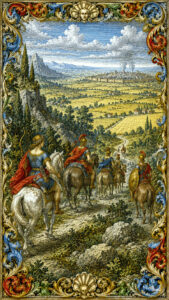
The Mountain That Raised Her
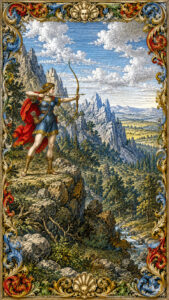
Atalanta was exposed on Mount Parthénion as an infant and raised by Megale, the mother bear, before any human hand claimed credit for it. By the time her father arrives to beg forgiveness, the wilderness is not background. It is the thing that made her, the source of a competence no one in Tegéa‘s court can match. When the warriors are ambushed on the path home and she alone holds her ground, nocking arrow after arrow, the text is careful to locate this in geography: the scrub thickening, the shadows deepening, the outlaws descending from “where the scrub thickens and the shadows deepen.” The land hides danger and reveals competence in the same breath. It does this because the mountain is where she belongs; the men around her, her father included, are guests in it.
What she has not yet realized is that she is about to trade competence for belonging, the mountain for the hall, a place where she is sovereign for a place where she will be a daughter. The crossing into “the golden fields of fertile Tegéa” marks the transition, fields being a thing that is owned, fenced, planted, harvested. Mountains are not. I did not need a line of dialogue where Atalanta says I am leaving my freedom behind. The geography already said it, several paragraphs before she would have had any reason to think it herself.
 The Palace That Watches Everything Except What Matters
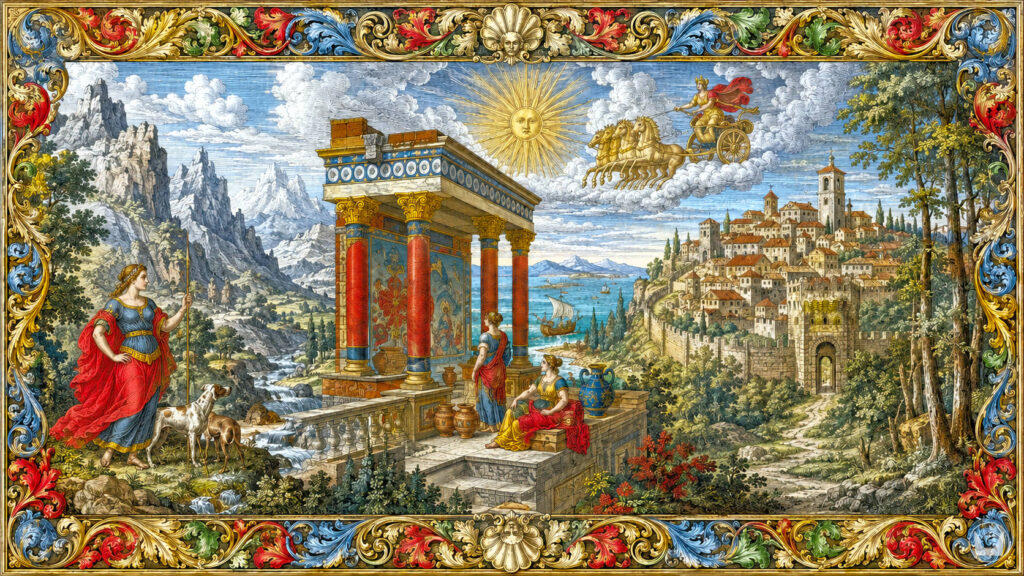
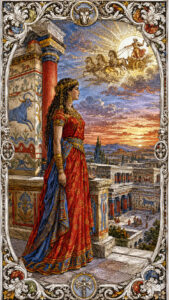
In Asterios and the Labyrinth, Knossos is a different kind of terrain problem, since I am not writing wilderness but architecture and ceremony. Frescoes of bull-leaping youths line the walls. Incense and perfume cover the smell of sweat at every feast. And Pasiphaë, late in the novel, stands on her terrace and has a thought that does real structural work for the whole sequence around it: her father’s chariot rides aloft and sees all that unfolds upon the ground, “yet what stirs in the minds of women he cannot discern.”
That line is doing two things at once. It is a thought about Helios, the sun, watching the kingdom from above; it is also a description of the palace, a structure built for surveillance of the visible and blind to the women plotting inside it. Meritamen‘s priestesses have smuggled sacred serpents into the sealed labyrinth while the court above continues its feasting. The architecture is performing the exact blindness the plot depends on: a place built to be seen through, except where the danger is. Pasiphaë has not yet articulated a plan for what she will do about Meritamen when this scene opens. By the time she draws the dagger across her palm, the terrace has told the reader what kind of queen she will become.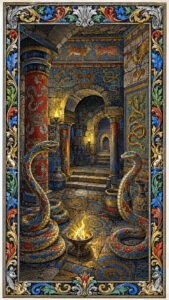
The Wall That Encircles Cortona
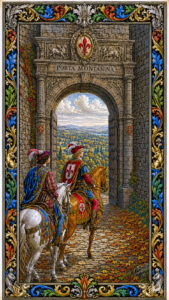
This terrain is the trickiest because it works through a single act of crossing rather than atmosphere held over many pages. In A Tale of Paris & Paris: Echoes of Troy, Lorenzo and Vittorio ride through Cortona‘s streets until they reach Porta Montanina, one of the eight gates in the old Etruscan walls. From there the land opens into “a sweeping vista of the verdant vale below.” They continue on the road for a short while and then leave it. They “forsake the narrow way” and ride into the forest the Etruscans once cleared back from the city, on the theory, Lorenzo guesses, that it was for defense, or for timber, or both.
Three miles in, past anything Cortona‘s law can govern, lives Milena the Ancient. She is the town’s healer and the Inquisition’s eventual target. The geography of where she has been pushed is not incidental. The wall is the edge of what the city will sanction. The forest beyond it is where the unsanctioned survive, by virtue of being unreachable. Nobody in this scene says aloud that Milena exists because Cortona has decided certain kinds of knowledge and women do not belong within the citadel. The distance between the gate and her cottage says it. By the time Lorenzo finds her and the conversation turns to inquisitors and accusations of sorcery, the terrain has explained why she lives there.
 Why the Terrain Speaks First
These three settings were not designed as a matched set. I only saw the pattern in hindsight. But each stages a boundary: wild against owned, visible ceremony against hidden plotting, what a city permits against what it does not. In each case the character has not yet said what the crossing means. Atalanta does not announce that she is trading freedom for family. Pasiphaë does not announce that she will fight for her line by any means necessary. Lorenzo does not announce that Cortona built a wall to exclude people like Milena.
Terrain does not lie the way people do. A mountain stays a mountain no matter what a person standing on it wants to believe. A wall stays a wall whether or not the city behind it wants to admit what it was built to keep out. I trust this as one of the oldest tools in the register I write in: a reader will feel a boundary crossed before any character finds words for what it cost them to cross it.
Rio de Janeiro, the xxi day of June, MMXXVI.

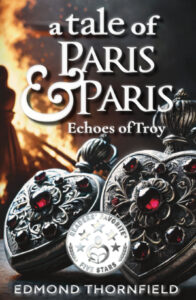
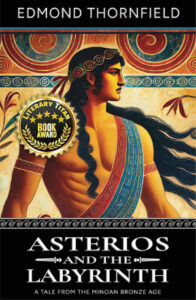
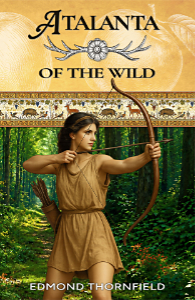
Click any cover to read a preview chapter and learn more.