Why Does AI Writing Give Its Characters Lines Instead of Voices?
This is Essay 21 of 22 in the series Why Choose 100% Human Authors, addressed to readers who want to understand what a human author does that a machine cannot and why that difference matters to the experience of literary fiction.

There is a kind of historical prose that announces its era in the first sentence and then abandons it. The vocabulary signals the period: forsooth, prithee, methinks, a thee or thou placed where the rhythm seems to require one. The syntax beneath these signals is modern. The worldview the characters carry—what they fear, what they would never think to question—is that of a person living now, dressed for another age.
This is the borrowed voice: period language as costume rather than as living idiom, laid over modern sentence structures and assumptions, producing prose that sounds historical without being so. The failure is not one of research but understanding.
 The Costume and What It Conceals
A language model (LLM) asked to write in Early Modern English will reach for the recognizable markers. Dost thou, hath, wherefore, ’tis. It will distribute these with consistency. What it will not do is understand the grammar that governed them.
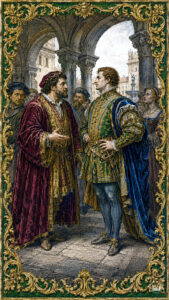
Thou and you were not interchangeable variants of the same second-person pronoun. Thou was intimate, condescending, or insulting depending on who used it and to whom. A merchant addressing a nobleman with thou was not being quaint. He was giving offense, whether he intended to or not. A father addressing his son with you was marking distance, not respect. The choice between them was a social act, and every speaker in that world knew it.
An LLM does not know this because knowing it requires not just the fact but the social texture that made the fact matter. It can produce a scene in which a servant says thou to his lord and no one responds as though anything has happened.
The human writer who has come to live inside a period knows what the word cost. They put it in the character’s mouth for the right reason, and the reader feels the scene shift without being told why.
 When the Worldview Stays Modern
The borrowed voice is not only a matter of language. It is also a matter of thought.
A character in fifteenth-century Florence does not experience the world as a modern person with period accessories. The understanding of illness, divine will, social order, desire, and fear is shaped by taken-for-granted assumptions that would not be perceived as such. They are the texture of reality as those people lived it.
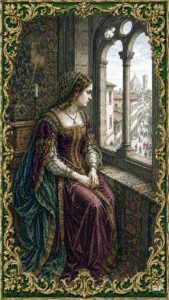
AI-generated historical fiction tends to produce characters who hold these assumptions as given, if at all. A young woman in a Renaissance household will chafe against her constraints in language that belongs to a much later century. A soldier in a medieval campaign will reflect on the ethics of violence in terms that owe more to the twenty-first century than to the world that formed him. The period details—the dress, the food, the weapons, the architecture—are all present, yet the interiority remains contemporary.
This is worldbuilding without depth: the surface of a period reconstructed with care, and the mind of a modern person installed behind it. The reader who knows the period feels the seam. The reader who does not is given a false picture of what it was to be human then, in that place.
 Human Writers Are Not Immune
It would be dishonest to frame this failure as the exclusive property of machines. Most contemporary historical fiction errs in this way. The borrowed voice is comfortable because it is legible: modern syntax with period decoration invites quicker reading than prose that has absorbed an earlier idiom. And characters who think and feel in modern terms are easier to sympathize with than characters whose assumptions are alien.
The error is still an error.
A human writer can recognize it by asking of any sentence: does this belong to this world, or have I imported it? They can feel the difference between a character whose resistance to circumstances arises from within the logic of their time and one whose response is the modern virtue of self-determination.
The correction requires two things that cannot be separated: knowledge of the period and the judgment to apply it at the thought level, not only in detail. Research supplies the facts. Judgment determines which facts carry weight and which are decoration.
 What the Human Author Does
A writer who has inhabited a period does not reach for archaic vocabulary as a signal. They reach for the sentence structure, the rhythm, the patterns of analogy that belong to people who thought in that idiom. Their characters do not explain their world to the reader because they do not experience it as requiring explanation. They move through it with the ease of people for whom it is how things are.
This is not a skill that can be assembled from a list of words and a summary of historical conditions. It is the result of sustained attention to how a period thought, not only to what it contained. The writer who has read the letters, sermons, recipes, legal documents, and marginalia of an era does not know more facts about it. They have spent time inside a mind shaped by it, and that leaves traces in every sentence they write for characters who lived there.
The language model has processed those same documents and borrowed the voice; it has not spent time inside them. The writer’s voice is earned.
Rio de Janeiro, the iii day of July, MMXXVI.