Why Does AI Writing Produce Places That Could Be Anywhere?
This is Essay 19 of 22 in the series Why Choose 100% Human Authors, addressed to readers who want to understand what a human author does that a machine cannot and why that difference matters to the experience of literary fiction.

 The Backdrop That Is Not a World
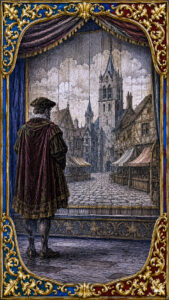
There is a kind of setting that gets everything right and delivers nothing. The prose names a medieval market town and gives you cobblestones, a church with a square tower, stalls selling bread and cloth, the smell of animals, a castle on the hill. You have been placed. You have not arrived anywhere.
This is the generic setting: a location assembled from the components its category requires, present as a list of period-appropriate features rather than as a place that exists beyond the story being told in it. The medieval town is there because the story needs one. It has not been observed. It has been constructed from what medieval towns are understood to contain, and the construction is accurate in every particular and specific in none.
The difference between a backdrop and a world is the difference between a painted façade and a room you can walk into. The façade gives you the correct visual impression. The room has a smell, a temperature, a corner that is often in shadow, a window that sticks, a draught that comes from somewhere no one has ever traced. These are not decorative details. They are evidence that someone was there before the story required it.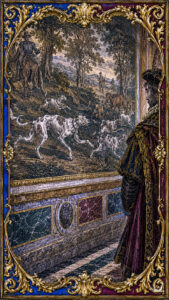
What Generic Looks Like
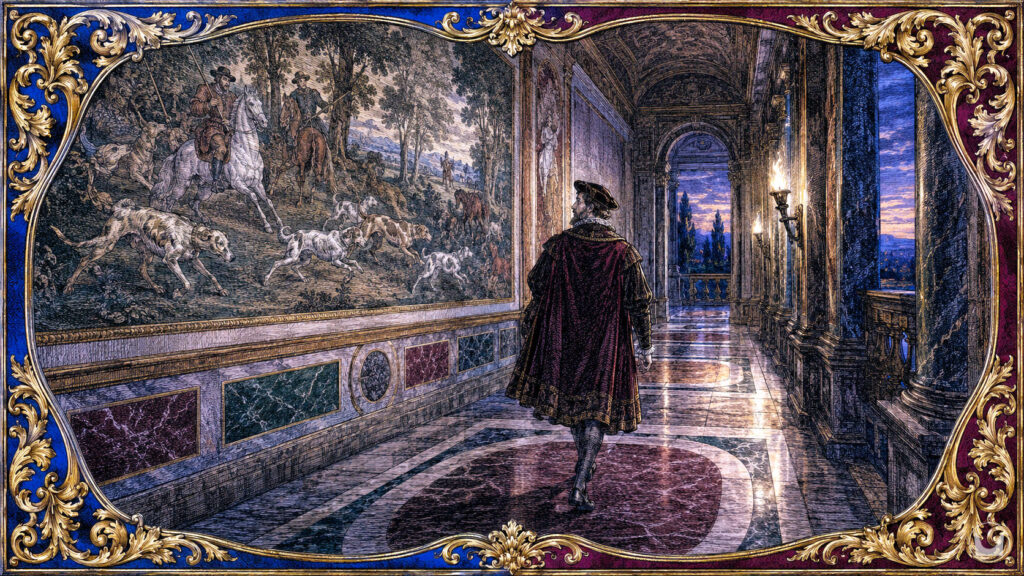
Consider an invented example: a scene opens in a Renaissance palazzo at dusk. The prose gives you marble floors, frescoed ceilings, torches in iron brackets along the corridor, and a servant crossing the courtyard below with a lamp. The character moves through these spaces on his way to a meeting that will determine the plot.
The description is not wrong. A Renaissance palazzo at dusk had marble floors, frescoed ceilings, torches, servants with lamps. But the reader has been given the category rather than the instance. Which palazzo? Whose frescoes and of what subject? What does the marble floor do underfoot at this hour when the stone has been cold since morning, and does the character notice it through his boots? What does the courtyard smell like at dusk in this city in this season?
Now introduce a detail no one would have thought to include: the fresco on the left wall of the corridor depicts a hunting scene, and one of the hounds has been painted with a slight error in its forelegs that gives it a loping, almost comic gait, and the character who has walked this corridor a hundred times glances at it without stopping because the hound has always bothered him and he has never said so to anyone. Now the palazzo is a distinct palazzo. Now the character is a person who has a history with this place. The reader has been somewhere.
 The Smell, the Temperature, the One Detail
The generic setting fails most at the level of the senses it omits. A language model describes what a place looks like. It has been trained on text that is largely visual in its descriptive habits, and it replicates those habits. The result is settings that can be seen and not entered.
A place in literary fiction is not a visual fact. It is a sensory experience that a character has under specific conditions. The ancient battlefield two days after the fighting has a smell that has nothing to do with how it looks. The Renaissance kitchen in July is a different room from the same kitchen in January, and a cook who has worked in both senses the difference before recognizing it.
None of these details come from knowing what a battlefield or a kitchen contains but from knowing what it is to be a body in a place at a certain time. A language model can name every object in the kitchen. It cannot be warm or cold in it.
Human Writers Are Not Immune
A human author in early drafts often produces backdrop-level settings. The first pass at a scene tends to be a stage direction: here is the room, here are its features, now let the characters proceed. The medieval town appears as its own Wikipedia entry. The palazzo is every palazzo.
The distinction is not that they see their settings whole from the first draft but that they can ask which detail is theirs alone: the one that no one else would have included because no one else has stood in that place at that hour, or because no one else has looked at the lame hound and felt irritated by it across twenty years of passing. This detail must be discovered either through research so thorough that the writer has inhabited it or through direct experience of somewhere close enough that the body’s knowledge transfers.
The generic setting is always correctable by a human writer who questions: what do I know about this place that is mine and no one else’s? A language model cannot ask this. Every detail it has comes from the same archive. No corner of any room belongs to it alone.
 What a Human Author Does
A writer who has stood in a certain setting carries the experience into every subsequent one of that type they go on to create. They do not describe a Renaissance corridor; they describe this one, which is cold in a way that recalls another in a different city, and the memory of that real corridor gives the imagined one a detail it could not otherwise have had. Research does the same work when it is thorough: the writer who has read widely about a place begins to know things about it that do not appear in any single source; they have assembled enough particulars for it to become inhabitable in imagination.
The reader who enters such a setting does not think: this is a well-described medieval town. They think nothing about the description because they are inside it, and it has dissolved into experience. This dissolution does not require a comprehensive inventory of period-appropriate features. It calls for a unique detail to convince the reader that someone was there before them.
The generic setting tells the reader where they are—the specific one puts them there. Only a writer who has been somewhere, in body or in imagination, can put a reader there.

Rio de Janeiro, the ii day of July, MMXXVI.