On the distance between The Iliad and The Odyssey and what archaeology reveals—and why a historical novelist must navigate between them.

Every reader who comes to Bronze Age historical fiction arrives carrying Homer. The wine-dark sea, the rage of Achilles, the cunning of Odysseus are the furniture of the Western imagination when it turns toward ancient Greece. They feel authoritative. They feel old.
They are not old enough.
Homer composed his epics in the eighth century BC, some four hundred years after the collapse of the Mycenaean palatial civilization he appears to describe. The world of my novels, Asterios and the Labyrinth and Atalanta of the Wild, predates Homer by that same span—the distance that separates us from the Renaissance. A writer working in that period cannot treat The Iliad and The Odyssey as historical sources without first understanding that they are not a window onto the Bronze Age but a memory of it, transformed by centuries of oral transmission, cultural collapse, and partial reinvention.
 The historical novelist who navigates this gap does not discard Homer. He reads him with different expectations.
Were the Heroes of Troy Already Greeks?
Homer‘s warriors at Troy call themselves Achaeans, Argives, Danaans, regional and tribal names, never a single collective identity. The word we use, Greek, is a Latin coinage the Romans applied from outside. In Homer‘s own language, the people would eventually be known as Hellenes and their land Hellas, but in The Iliad that word, Hellas, refers only to a district of Thessaly. The unified Greece the word would come to signify did not yet exist.
Homer composed at the moment when something like a shared self-understanding was beginning to form. The founding of the Olympic Games in 776 BC, within living memory of his probable lifetime, created a space reserved for people who claimed shared descent to compete, drawing the first formal line between those who belonged and those who did not. Greek colonization across the Mediterranean, pressing outward into contact with foreign cultures, sharpened the awareness of what speakers of this language held in common. In The Odyssey, Homer coined the term barbarophonos for those who speak a tongue that sounds like bar-bar-bar, the sound of language that is not yours. The concept required an us to define a them.
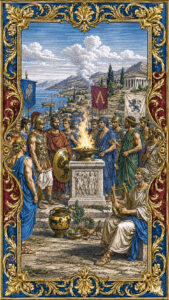 But in Homer‘s day, the Greeks remained local in their loyalties. An Athenian regarded a Spartan as almost a foreigner. They fought each other with the same ferocity they directed outward. Political unity would not come until conquest imposed it centuries later.
What Homer‘s poems did was help create the unified identity that did not yet fully exist when he composed them. By weaving regional myths into vast pan-Hellenic epics, The Iliad and The Odyssey became the shared scripture of the Greeks, giving later generations a cultural inheritance to gather around.
The Bronze Age setting my novels inhabit preceded all of this. Knossos, Kydonia, Khalydon, Tegea are not proto-Greek city-states feeling their way toward unity. They are palatial civilizations organized around distinct political, theological, and social principles, whose relationship to what would later be called Greece is related by distant ancestry, not continuity.
 Did Homer Know the Minoans?
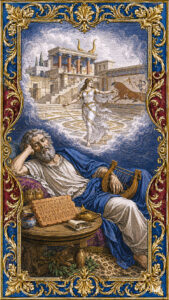
He did not—not as a recognized society with a name and a history. The word Minoan was coined by the archaeologist Sir Arthur Evans in the early twentieth century, when excavation at Knossos first revealed what had been buried there. Homer, composing six hundred years after the Minoan collapse, had no name for the vanished world behind his inherited tales.
Yet the memory is there, distorted by time and transmission until it resembles myth.
In Book 19 of The Odyssey, Homer describes Crete as a wealthy island of ninety cities, populous and prosperous, a figure that carries the ancestral trace of Bronze Age Crete‘s actual density and reach. He mentions the Eteocretans, the true Cretans, as a different ethnic group among the island’s inhabitants. Linguists and archaeologists identify these as the descendants of the non-Greek Minoans who survived into the Iron Age, still speaking their non-Greek language.
King Minos appears in The Odyssey‘s Underworld, presiding as a divine judge over the dead, a figure of immense authority, half-remembered from the distant past when the oral tradition that produced Homer began. On the shield of Achilles in The Iliad, Homer describes a dancing floor that Daedalus made for Ariadne in Knossos, its design matching the large paved theatrical areas excavated in the Minoan palaces. These details could not have been invented; Homer could not have seen them.
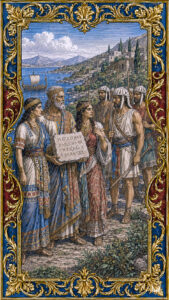 The Phaeacian kingdom in The Odyssey reflects the archaeological record of Minoan maritime supremacy and palace life better than anything in Homer‘s eighth-century world. Yet Homer had no historical knowledge of the culture he was describing.
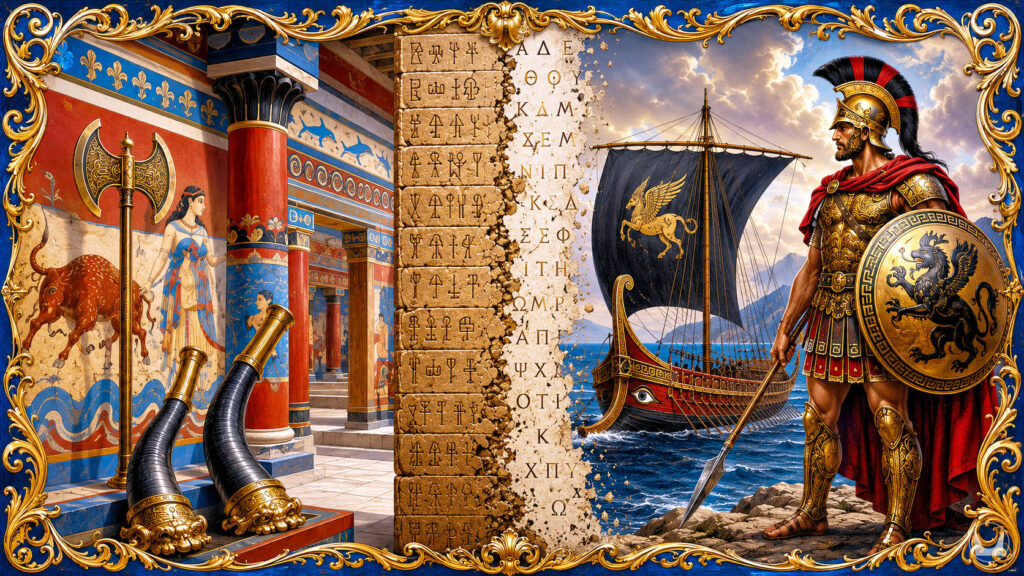
The Minoans shaped Homer‘s language as well as his imagery. Linear A, the Minoan script, was adapted by the Mycenaean Greeks into Linear B when they absorbed Minoan Crete. The script was lost in the collapse, but loanwords for luxury goods, plants, and geography survived in the Greek epic vocabulary Homer used.
For a novelist writing Knossos, this matters. The Minoans Homer remembers are not the Minoans I write. What I write is the source of the memory—the civilization before it became an echo in another culture’s epic tradition. The novelist’s task is to reverse the transformation: to find, beneath the myth, the human reality that generated it.
 Did Homer‘s Warriors Fight Like Bronze Age Warriors?
They did not. What Homer describes is a composite: Bronze Age memory overlaid with the military culture of his own transitional era, filtered through four centuries of oral tradition.
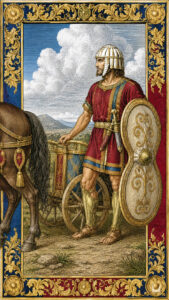
The Mycenaean warrior fought in equipment unlike the Greek soldier of the Archaic period. His helmet was fashioned from the tusks of boars, arranged in overlapping plates on a leather base, a construction so labor-intensive it represented significant wealth. His shield was a full-body construction of multiple layers of ox-hide on a wooden frame, shaped in the figure-eight or tower form that appears in Minoan frescoes. His armor, where it existed at all, was rudimentary by later standards. His sword was bronze, not iron.
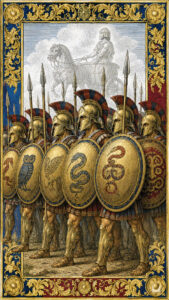 Homer‘s eighth century BC was a transitional moment in Greek warfare. The aristocratic warrior dismounting from the chariot to engage in individual combat, the mode that structures The Iliad‘s battle scenes, was already giving way to something new: the hoplite, the citizen-soldier fighting in the disciplined shoulder-to-shoulder formation of the phalanx with his large round shield and iron-tipped spear, who would become standard in the generations that followed.
What Homer describes is neither one nor the other. His heroes ride chariots that the archaeology of Bronze Age warfare supports, then dismount for individual duels in a manner influenced by the aristocratic martial culture of his own era. The armor he describes preserves elements of the older world while reflecting later traditions. He was not writing military history. He was composing an epic, drawing on accumulated tradition that had already blurred the lines.
The novelist must look past Homer to the frescoes, the grave goods, and the Linear B records, and accept that the warrior they put on the page will look nothing like Achilles.
 Whose Gods Were They?
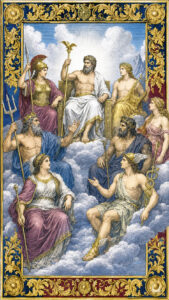
Homer‘s gods are the Olympians. Zeus rules the sky, Poseidon the sea, Hades the underworld. Athena, Apollo, Ares, Aphrodite, and Poseidon intervene in human affairs with the casual authority of a ruling family managing its estates. The hierarchy is stable, the personalities are vivid. The primordial forces and the Titans exist only as defeated history, banished to Tartaros.
This is not the pantheon of the late Minoans or Mycenaeans.
What those palatial civilizations worshipped, and how, is a question the archaeology illuminates only partially. The great goddess—or goddesses—whose image dominates Minoan religious art. The symbols recur throughout: the double axe, the horns of consecration, the bull, the snake, the sacred tree. Divine presence that appears bound to specific places, rituals, and times of year. A religion rooted in the world rather than a celestial court. The Divine Bull, the theological foundation upon which Lord Koronos builds his objection to King Asterios, is a Bronze Age religious concept with no exact equivalent in the Olympian system Homer describes.
The Olympians are products of a later reality, carrying traces of what came before but reshaped into something more personalized to a culture that was beginning to think of itself as unified. Homer drops his readers into a universe where this new order is complete and the preceding age is myth. The novelist must go back before that change—to a time when the sacred is not a family on a mountain but a force woven into the land, the sea, the animal, and the palace wall.
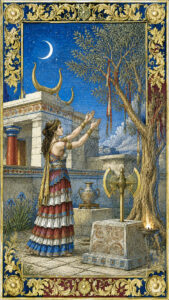 This is where the distance between Homer and the Bronze Age matters most. A writer who accepts the Olympians as the religion of Knossos has accepted a mistake. The gods I write are older than Homer‘s gods, stranger, less legible, and closer to the ground.
What the Novelist Does With Homer
None of this means Homer is useless to the historical novelist. The Iliad and The Odyssey are vast repositories of preserved oral tradition, carrying Bronze Age material that survived because it was too embedded in the poetry to be edited out. The boar’s tusk helmet appears in The Iliad even though no eighth-century Greek wore one. The ninety cities of Crete, the dancing floor of Ariadne, the Eteocretans are traces of a world Homer did not know he was remembering.
The novelist reads Homer as a palimpsest: the eighth-century text written over an older one, the older one still legible in places. He takes what the archaeology confirms and questions what the oral tradition has transformed. He does not mistake the transformation for the original.
And he accepts a discipline that Homer, composing an epic, did not require of himself: the discipline of not knowing. Much of that civilization is lost—the religious system, the social structure of Knossos, the inner life concealed behind a script we cannot read. The novelist who works in that past must be willing to imagine within the constraints of what is known and leave open what the evidence does not close.
Homer closed everything. He gave the Bronze Age heroes the names, gods, and values of his own age, refracted through centuries of transformation. The historical novelist’s task is to open it again and find, behind the legend, the human world Homer remembered without understanding.
Rio de Janeiro, the vi day of July, MMXXVI.

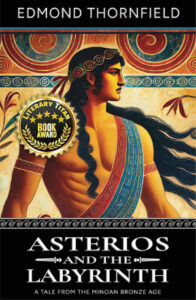
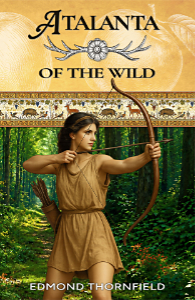
Click any cover to read a preview chapter and learn more.

Further Reading
Readers who wish to explore the relationship between Homer, the Bronze Age, and the archaeological record may find the following works especially rewarding. They approach the subject from different disciplines—history, archaeology, philology, and literary criticism—but together they illuminate the remarkable distance between the world Homer inherited and the civilization he remembered.
- The World of Odysseus (1954), by Moses I. Finley. A classic study of the social world reflected in the Homeric epics and the problems of treating them as historical evidence.
- The East Face of Helicon: West Asiatic Elements in Greek Poetry and Myth (1997), by Martin L. West. An influential examination of the Near Eastern traditions that shaped early Greek poetry and myth.
- The Mycenaean World (1976), by John Chadwick. A concise introduction to Mycenaean civilization by one of the scholars responsible for the decipherment of Linear B.
- The Archaeology of Greece (1996), by William R. Biers. A broad archaeological survey placing the Bronze Age within the wider development of Greek civilization.
- 1177 B.C.: The Year Civilization Collapsed (2014), by Eric H. Kline. An accessible account of the Late Bronze Age collapse and the interconnected Mediterranean world that preceded it.
- The Oxford History of the Classical World (1986), Editors: John Boardman, Jasper Griffin, Oswyn Murray. A comprehensive overview of the ancient Greek and Roman worlds, including the transition from the Bronze Age to the historical periods.
- The Past Is a Foreign Country (2015), by David Lowenthal. A profound exploration of how later generations imagine, reconstruct, and sometimes misunderstand the past, offering valuable perspective for both historians and historical novelists.
This essay is written for readers and historical novelists rather than as a work of academic scholarship. The books above are offered as starting points for those who wish to pursue these questions in greater depth.
Other essays in this ongoing series on the Bronze Age Aegean, the Homeric tradition, and the craft of writing historical fiction set in the ancient Eastern Mediterranean are available in the blog archive at ethornauthor.com.
Related essays include: