On the distance between the Bronze Age world of Atalanta of the Wild and the Classical Greece readers bring to the page, and why that distance matters to the fiction.

Most readers arrive at a Bronze Age novel carrying Greece with them—the Greece of the Parthenon, of the city-state, of the agora, and of the Olympic Games. That Greece is deeply embedded in the Western imagination. The difficulty is that it has almost nothing to do with the world of Atalanta of the Wild.
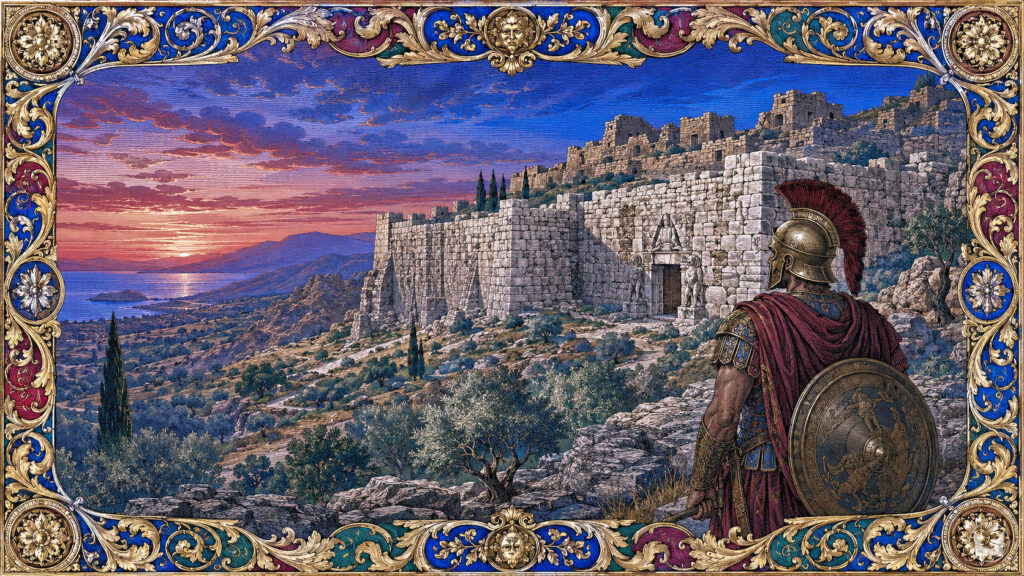
 The world Atalanta inhabits, Arcadia and the Peloponnese circa 1250 BCE, predates Classical Greece by eight centuries. It is separated from Pericles not by a generation or two but by a gulf so wide that the people on one side of it could not have recognized the people on the other. The religion was different, as were the political organization, the material culture, and even the very name by which they were known.
This essay is an attempt to map that distance, not to exhaust it, which no essay could, but to make it legible. Four questions, four answers, and at the end of each, a clearer picture of the world the fiction is trying to render with fidelity.
I. They Did Not Call Themselves Mycenaeans
The word Mycenaean does not appear in any Bronze Age document. It is a modern archaeological label, coined after Heinrich Schliemann excavated the citadel at Mycenae in the 1870s and gave the civilization a name derived from the site. The people who rebuilt the palace at Knossos, administered Pylos and Tiryns, and sent ships across the Eastern Mediterranean had no collective word for themselves that we can be certain of. What they had were the names found in the Homeric epics and in the records of their neighbors.
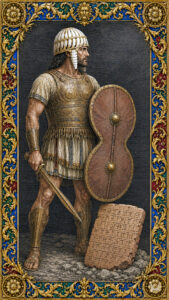 The Hittites, whose empire occupied Anatolia and whose archives have survived in substantial quantity, refer often to a western maritime power they call Ahhiyawa. Many scholars now believe this is the Hittite rendering of Akhaioi—Achaeans, the name Homer uses for the Greek forces before Troy. If the identification is correct, and the majority of specialists think it is, then the Late Bronze Age Greeks may well have called themselves Achaeans centuries before the Homeric epics preserved the word in verse.
Homer also uses Danaans and Argives as collective names for the same people. The Danaans (Danaoi in Greek) appear with nearly the same frequency as Achaeans in The Iliad. The Argives, literally the men of Argos, he extends to mean all the Greek warriors, not only those from a single city. Whether these names preserve Bronze Age designations or are poetic variations is harder to determine. But they are the names available to a historical novelist who wishes to write the ancient world as its inhabitants understood it.
One name absent from that list is Hellenes. In Homer, Hellenes refers to a small group in Thessaly associated with Achilles. It does not mean all Greeks. That broader identity that would eventually produce the word Hellenic developed in the Archaic period, after the Bronze Age had collapsed. The Greeks of Atalanta‘s world were not Hellenes. They were Achaeans, or Danaans, or the men of a particular kingdom, and the distinction is not pedantic. It is the difference between writing the world that existed and writing a projection of what came later.
 II. The Laconian Question: Were the Predecessors of the Spartans Also Achaeans?
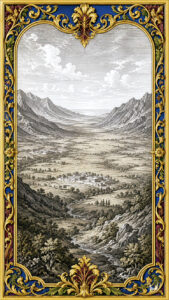
The land that became Sparta, the region of Laconia in the southern Peloponnese, was part of the Mycenaean world. The major palace of the region stood at a site near Therapne, and the archaeological record shows Laconia participating in the same material culture, comparable administrative practices, and likely the same linguistic community as Mycenae, Pylos, and Tiryns. If the Mycenaean Greeks called themselves Achaeans, then the people of Bronze Age Laconia were Achaeans too.
Homer reflects this without apparent difficulty. Menelaus is king of Sparta. His brother Agamemnon leads the Achaean coalition. No distinction of origin or name divides them. The men of Laconia fight under the same collective name as their fellow Achaeans.
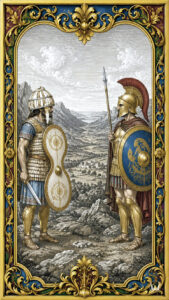 What happened after the Bronze Age collapse is a separate question. The destruction of the palaces ushered in centuries of movement, reorganization, and the gradual formation of new identities. By the Archaic and Classical periods, the Spartans identified themselves as Dorians, a distinct branch of the Greek-speaking world, with a different dialect and founding tradition from the Ionians of Athens or the Aeolians of Boeotia. The Dorian identity was not inherited from the Bronze Age. It emerged from the disruptions that followed this upheaval, through processes that remain debated among scholars.
The fascination for the historical novelist lies in this discontinuity. The land remained the same. The ruins of the Mycenaean world remained visible across it: the great walls at Mycenae and Tiryns, and the ancient tombs the later Greeks called the graves of heroes. But the civilization that had built those structures was no longer understood by the people who looked at them. The Spartans who passed the cyclopean walls at Tiryns did not know they were looking at the administrative seat of their predecessors. By that point, they were strangers to their own past.
 III. The Minoans and the Achaeans: Conquest, Assimilation, and What Remained
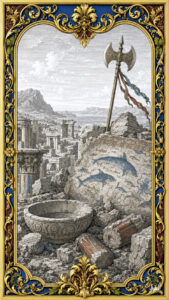
Around 1450 BCE, within living memory of Atalanta‘s generation, something decisive happened in Crete. Most of the great Minoan palaces were destroyed. Phaistos, Malia, and Zakros fell, while only Knossos endured, though its administration had changed. The language of the records shifted from Linear A, the Minoan script that remains undeciphered to this day, to Linear B, the earliest written form of Greek. The administrative practices resemble those of the mainland centers. The material culture reflects Mycenaean rather than Minoan conventions.
The prevailing scholarly view, despite some dissent, is that Mycenaean Greeks—Achaeans—took political control of Crete sometime around 1450 BCE. Whether by invasion, internal upheaval with outside support, or some combination of the two, the subsequent rulers of Knossos appear to have been Greek-speaking, and they governed using institutions the Minoans had already built.
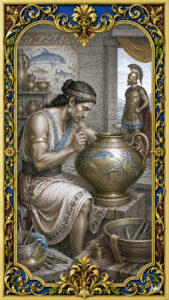 What matters for the fiction, and what the evidence makes clear, is that the Minoans did not disappear. The archaeological record shows no wholesale replacement of population, no break in settlement continuity. The sanctuaries continued. The artistic motifs persisted. The craftsmanship that had made Minoan objects recognizable across the Eastern Mediterranean did not vanish because the palace scribes were now writing in a new language.
What happened instead was gradual assimilation. Over succeeding generations, the distinction between conqueror and conquered softened. Intermarriage was inevitable. Languages influence one another even when one holds power. Religious practices merge across the boundaries of conquest. By the end of the Late Bronze Age, Crete had become part of the wider Mycenaean sphere while remaining unmistakably Cretan, a civilization that bore the marks of both traditions and could be reduced to neither.
This layered inheritance is not background detail in Asterios and the Labyrinth or Atalanta of the Wild. It is the world the characters breathe.
 IV. After the Collapse: What the Darkness Conceals and What It Preserves
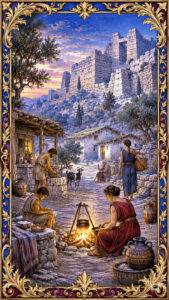
Around 1200 BCE, the palatial civilization of the Bronze Age Aegean came to an end. Not through the slow decay of institutions over generations, but within a few decades. The palaces at Mycenae and Pylos were destroyed and never rebuilt. Tiryns was damaged. The Linear B tablets ceased to be produced when the bureaucratic system that had sustained the scribes disappeared. Long-distance trade contracted sharply, and population declined across many regions. Monumental architecture ceased. The world the tablets describe ended.
The old order collapsed. The people did not. Across Greece, the descendants of the Mycenaeans continued to farm and marry, bury their dead, and tell stories. What they lost was the collective self-understanding that had organized their lives. The great walls at Mycenae and Tiryns were still visible. Stories of the men who had built them—Agamemnon, Menelaus, Achilles, Odysseus—continued to be told around fires in settlements far smaller and less organized than the world those stories remembered.
Whether ordinary people in 1000 BCE still called themselves Achaeans is a question the evidence cannot answer. The evidence for that period is sparse. The regional identities that would define the historical Greek world took shape in the darkness: Dorian, Ionian, Aeolian, and Achaean in the northern Peloponnese. How they formed, whether through migration, gradual infiltration, elite replacement, or internal social change, remains a contested question of Greek history. No definitive conclusion can be drawn, and anyone who offers one with confidence is working beyond what the record supports.
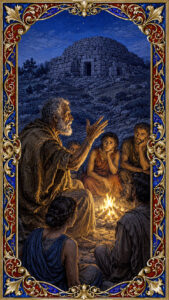 What the novelist can hold onto is this: in 1050 BCE, the person living on the site of a former Mycenaean settlement would not have known he was inhabiting a Dark Age. He would have known his grandfather spoke of larger settlements, that old structures lay in ruin nearby, that certain stories were told of men greater than any he had encountered. He would have identified himself first by family and village, then by the local chief who offered protection, and perhaps not at all by any broader ethnic category.
When the Homeric epics emerged in the eighth century BCE, the Greeks had become archaeologists of their own past. They could see the cyclopean walls. They could not read the tablets. They could tell the stories yet could not recover the society they described. Their tales are not Bronze Age documents. They are the memory of a memory—vivid, partial, transformed by centuries of oral transmission, and already at a considerable remove from the civilization they appear to describe.
That distance is not a failure. It is the condition of all historical memory. Every generation reaches toward the past with incomplete evidence and the assumptions of its time. The Greeks who inherited those traditions were doing what modern historians and historical novelists continue to do: trying to reconstruct a vanished world from the fragments it left behind. The difference is that more traces survive today, and they tell us that what Homer described was never historical reality.
Atalanta of the Wild is set in the historical world, not in Homer‘s memory of it. The distance between the two is the distance this essay has tried to map.
Rio de Janeiro, the vi day of July, MMXXVI.

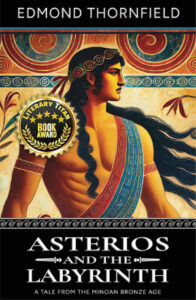
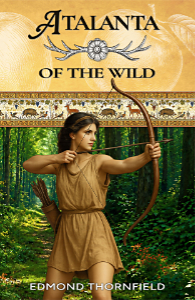
Click any cover to read a preview chapter and learn more.
Other essays in this ongoing series on the Bronze Age Aegean, the Homeric tradition, and the craft of writing historical fiction set in the ancient Eastern Mediterranean are available in the blog archive at ethornauthor.com.
Related essays include:
- Homer’s World Is Not the Bronze Age
- Writing the Unknown: How Historical Fiction Reconstructs Ancient Greek Religion
- Seven Books That Will Make You a Better Historical Fiction Writer
- Five Works of Classical Scholarship Every Historical Fiction Reader Should Know