For those who wish to explore the relationship between Homer, the Bronze Age, and the archaeological record—and to understand why the distance between them matters to anyone who writes in that world.

A historical novelist working in the Bronze Age Aegean faces a problem no amount of imagination alone can solve: the world he is writing about has survived in fragments. The palace records are bureaucratic inventories. The religious system is legible only through its objects. The script the Minoans used to write their language has never been deciphered. And the one vast literary source that feels authoritative, Homer, turns out to be a memory of the Bronze Age composed four centuries after its collapse and already transformed by oral transmission into something that resembles the original only at a distance.
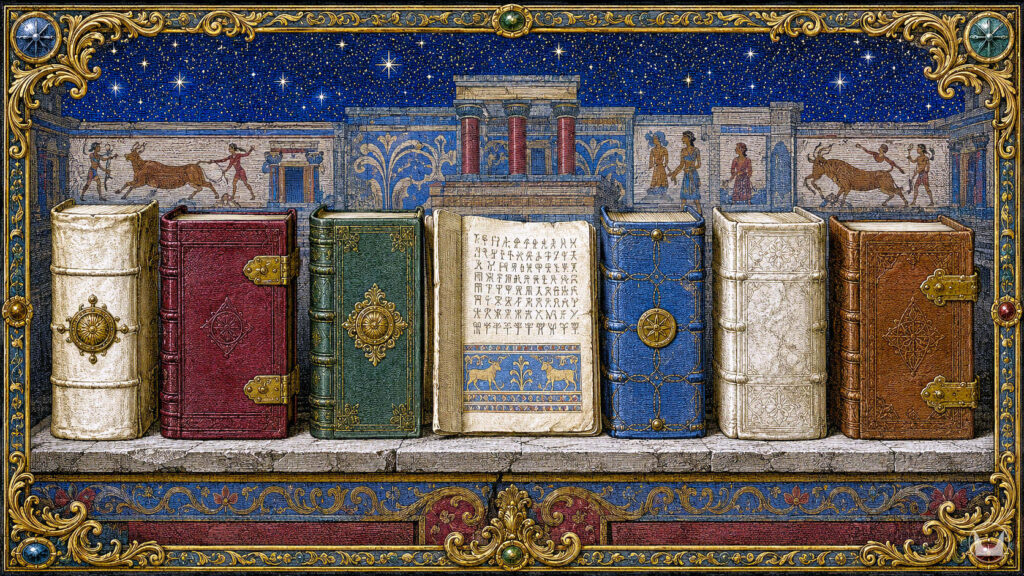
The seven books below do not solve that problem. No book can. But they illuminate it from different angles—history, archaeology, philology, and the philosophy of historical memory—and a writer who has spent time with all of them will bring a different quality of attention to the page. They are the kind of books that change how you see the material, and that change does not leave you when you close them.
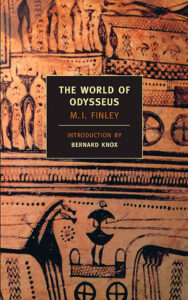 1. The World of Odysseus (1954), Moses I. Finley
This is the book that asked the question most readers of Homer had never thought to ask: what society do The Iliad and The Odyssey reflect, and is it the one they appear to describe? Developed with clarity, Finley‘s answer is that the Homeric epics are not reliable evidence for the Mycenaean Bronze Age and should not be treated as such. What they reflect is a composite social world, part memory, part invention, part the aristocratic culture of Homer‘s own Dark Age Greece, that cannot be pinned to any single historical moment.
For a historical novelist, this matters because it names the trap. The temptation to use Homer as a primary source for Bronze Age life is understandable; the epics are vivid, authoritative in tone, and full of specific detail. Finley demonstrates, methodically and without condescension, why that temptation should be resisted. The book is also a pleasure to read: precise and written by a scholar who understood that readability is not the enemy of rigor.
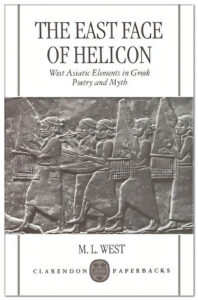 2. The East Face of Helicon: West Asiatic Elements in Greek Poetry and Myth (1997), Martin L. West
West‘s argument is that Greek epic and myth did not emerge from the Aegean world in isolation. At a deep structural level, the traditions that produced Homer were shaped by the poetry, mythology, and cosmology of the ancient Near East—the Levant, Anatolia, Mesopotamia—filtered through centuries of contact and cultural transmission. The parallels West documents are not superficial resemblances. They reach into the architecture of the epics themselves: narrative patterns, divine genealogies, the treatment of the underworld, the figure of the hero.
For a novelist writing the Bronze Age Aegean, this book opens the world outward. Knossos and Mycenae were not self-enclosed palatial cultures. They were nodes in a Mediterranean-wide network of exchange that extended east into the Hittite empire and south into Egypt. The gods, the myths, and the stories carried along those trade routes left traces in everything that came after, including Homer. West‘s scholarship is dense in places, but the argument repays the effort, and the novelist who absorbs it will write a more interconnected ancient world.
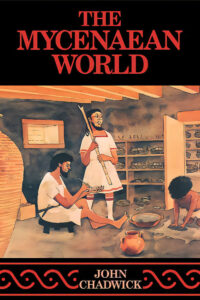 3. The Mycenaean World (1976), John Chadwick
Chadwick and Michael Ventris were the scholars responsible for the decipherment of Linear B in 1952, one of the great intellectual achievements of the twentieth century. This book tells general readers what the Linear B tablets reveal about Mycenaean civilization: its palace economy, its social hierarchy, its administrative apparatus, its religion. The picture that emerges is not the world of Homeric heroes but something more bureaucratic and in many ways stranger.
The tablets are mostly administrative records: lists of livestock, grain, bronze, cloth, and personnel. They are not literature. But approached with care, as Chadwick reads them, they reveal the texture of daily life in the palace world with a specificity no epic can provide. For the novelist, this book is an antidote to romanticization. The Mycenaean world was a managed economy with scribes, accountants, and supply chains. That reality, set alongside the heroic tradition, produces the kind of tension historical fiction thrives in.
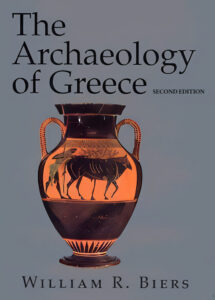 4. The Archaeology of Greece (1996), William R. Biers
Where Chadwick focuses on the Mycenaean world, Biers provides the broader archaeological context: a survey of Greek civilization from the prehistoric Aegean through the Hellenistic period, organized around the material evidence. It reads like a textbook—systematic, reliable, comprehensive, and designed to orient a reader who needs the full picture before narrowing to a period.
For the historical novelist, its value is in the transitions. The book traces the movement from Bronze Age palatial culture through the Dark Age collapse and into the Archaic period in which Homer composed. It does so through objects, buildings, burials, and sites rather than through literary tradition. The gap between the Bronze Age the archaeology reveals and the Greece Homer describes becomes visible in the material record in ways that are difficult to convey through text alone. Biers makes that gap legible.
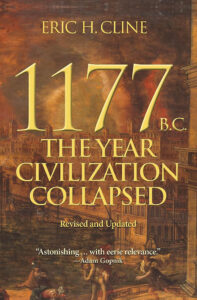 5. 1177 B.C.: The Year Civilization Collapsed (2014), Eric H. Cline
Cline‘s book is the most accessible on this list. Its subject is the Late Bronze Age collapse, the near-simultaneous destruction of the Mycenaean palaces, the Hittite empire, the Ugaritic city-states, and the Egyptian New Kingdom within a few decades of 1200 BC. It asks what caused that collapse, and his answer is that no single cause will do. What the evidence points toward is a convergence of interconnected failures: climate change, drought, internal rebellion, disrupted trade networks, and the migrations of the Sea Peoples, each stressing a system that was already under pressure.
For the historical novelist, this book does two things. It establishes how interconnected and prosperous the Bronze Age Mediterranean world was (the backdrop against which my characters Asterios, Lykosander, and Atalanta move), and it illuminates what the end of that world looked like from the inside. A civilization does not know it is collapsing. People go on administering, trading, building. The tablets keep being written until the scribes are gone. That human dimension lies at the heart of Cline‘s account, and it is the precise dimension the novelist needs.
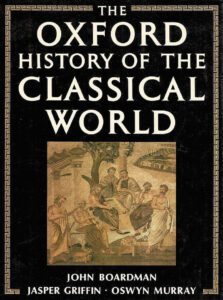 6. The Oxford History of the Classical World (1986), Edited by John Boardman, Jasper Griffin, and Oswyn Murray
This is a reference work rather than a continuous argument, and it should be used as one: a companion to consult rather than a book to read from cover to cover. Contributions from leading scholars cover the full sweep of Greek and Roman antiquity, from the Bronze Age through the late Roman Empire, with chapters on literature, philosophy, art, religion, and political history. The entries on Homer, early Greek society, and the transition from the Bronze Age to the Archaic period are particularly useful for the novelist seeking reliable orientation.
No single volume covers this ground with comparable authority and accessibility. For a writer who needs to move across periods and disciplines—checking a detail about Archaic Greek religion or the dating of a particular archaeological site—it is an indispensable desk reference. The novelist who owns this book will use it often and without apology.
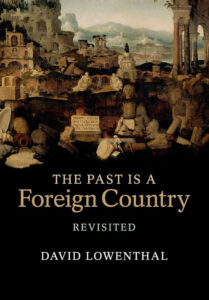
7. The Past Is a Foreign Country—Revisited (2015), David Lowenthal
This is the most unusual book on the list, and in some ways the most important for the historical novelist. Lowenthal‘s subject is not the Bronze Age or Greece or Homer. It is the relationship between later generations and the past they attempt to recover: how we imagine it, how we tend to distort it, what we project onto it, and why the past resists our efforts to make it legible.
The argument runs through history, memory, heritage, nostalgia, and the philosophy of historical knowledge, and it is relevant to every sentence written by a historical novelist. Acknowledging what the evidence does not tell us and resisting the temptation to fill the gaps with the present is easier to maintain when you have read Lowenthal. He does not tell us what the Bronze Age was. He reveals what it means to reach toward a past that is gone, and what honesty requires of anyone who tries.
This essay is written for historical novelists rather than as a work of academic scholarship. The books above are offered as starting points for those who wish to pursue these questions in greater depth.
Rio de Janeiro, the ix day of July, MMXXVI.

Other essays in this ongoing series on the Bronze Age Aegean, the Homeric tradition, and the craft of writing historical fiction set in the ancient Eastern Mediterranean are available in the blog archive at ethornauthor.com.
Related essays include: