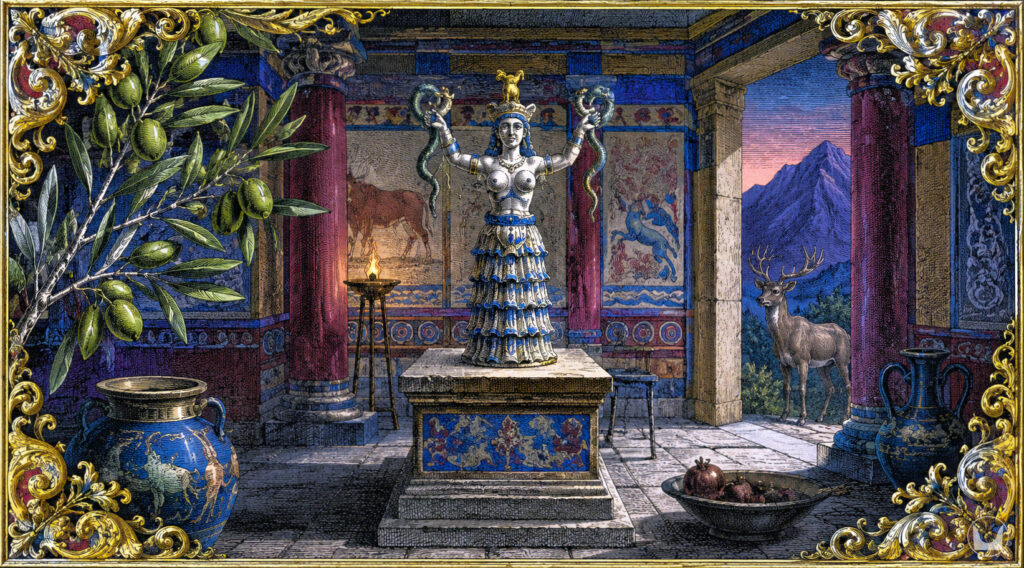
The question arrived before I wrote a single page of Asterios and the Labyrinth. I was standing by the reconstructed Tripartite Shrine at Knossos, watching other visitors move past without pausing, and I thought: I have to put a character here. He has to believe something about what he sees. And I do not know what that belief was.
That is the problem. The Minoans left no scripture. Their writing system, Linear A, remains undeciphered. The frescoes speak in images, not propositions. The seal stones show religious scenes whose meaning we cannot read. We know the objects of Minoan belief, or some of them, because they left physical traces such as statuettes, shrines, offering deposits, and altar tables. What they felt about those objects, the stories they told, and the names they invoked in prayer are largely gone.
And yet the novelist must go in. He cannot write a character who worships nothing or notices nothing. He must render belief from the inside.
This essay is about how I solved that problem across two Bronze Age novels, not by inventing freely but by working from what archaeology and ancient texts preserve. Four goddesses appear in those pages. Each required a different kind of reconstruction. Each taught me something different about the limits and the uses of disciplined imagination.
 I. Kore: The Goddess Without Her Name
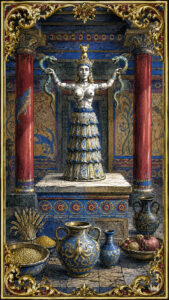
In Chapter One of Asterios and the Labyrinth, Asterios crosses the central court at Knossos and pauses at the goddess’s sanctuary. What he sees there is the cult image of the snake goddess, drawn from two famous faience statuettes found in the palace, now in the Heraklion Archaeological Museum. I describe her thus:
Kore bears the lovely image of a maiden, draped in fine linens dyed with Tyrian purple and other pigments. Legend has it she shares lineage with his father, being his half-sister from a goddess other than his Grandame Opa. She stands well pleased, breasts bared and arms outstretched, holding snakes to show her dominion over the Underworld.
The theological logic embedded in that passage reaches toward Persephone: the Underworld, the maiden aspect, the lineage through Zeus. But the name Persephone does not appear. It cannot appear. The novel takes place circa 1450 BCE, and Persephone, as a named figure in Greek religious tradition, belongs to the much later Archaic period. Whatever she was in the Bronze Age, she was not yet Persephone.
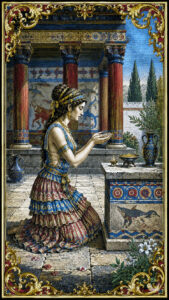 So I used Kore, the Greek word for maiden. This is not a sleight of hand. Kore is attested in Mycenaean Greek from roughly 1400 BCE, and kouros, its male counterpart, is equally ancient. The word predates the elaborate Persephone mythology even if it cannot be traced back to Linear A. I am working at the edge of what is known, not beyond it.
The discipline the choice demanded was strict. Every time Kore appears in the novel, I had to ensure that nothing from the later Persephone mythology crept in. No Hades. No abduction. No pomegranate. No Demeter‘s grief driving winter across the earth. Those are Archaic and Classical elaborations. What remains when they are stripped away is the oldest kernel: a maiden goddess, associated with fertility and the Underworld, worshipped with offerings. That I could use.
When a designation and a mythology have accumulated around an older religious reality, the novelist’s task is to peel them apart and work only with the residue that belonged to his period. The maiden goddess of the Knossos shrine probably had a name. We do not know it. Kore is not that name; it is a word that reaches toward the concept without claiming to recover the thing itself.
Sometimes that is the best a novelist can do—and it is enough.
 II. Pipituna: Writing a Goddess Whose File Is Almost Empty
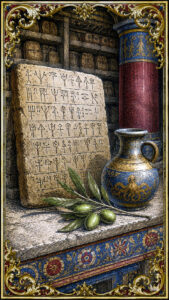
The second goddess asks something harder. Pipituna appears by name in the Linear B tablet KN Fp 13 from Knossos as a recipient of ritual olive oil offerings. That is, in its entirety, the contemporary documentary evidence. The tablet records an allocation. It does not identify her sphere, iconography, mythology, sacred animals, or relationships with other deities. It gives us a name and an offering, and then it stops.
From this almost nothing, I built a scene in Asterios and the Labyrinth in which the Cretan prince Lykosander, returning from a hostage exchange, greets the maidservants who come to tend him with this line: “Lo, Pipituna’s maidens bring the oil of life to cleanse and heal me.”
The association with olive oil is inferred rather than stated. The reasoning runs as follows: the tablet records oil distributions to divine recipients; Pipituna is one of those recipients; Minoan religion linked deities with the agricultural products most central to Cretan economic and ritual life. The olive was such a product, not merely food but fuel, medicine, anointing substance, and trade commodity. That Pipituna may have had a special relationship with the olive is possible. It is not established.
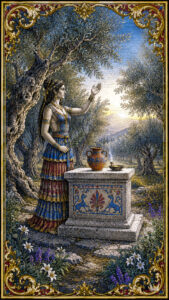 What the novelist does with this is a matter of conscience, not creativity. I have not presented Pipituna as the Minoan goddess of the olive; I have written a character who speaks of her as though the oil partakes of her nature. The difference matters. The first would be an assertion about Bronze Age religion. The second is a literary choice that remains inside the domain of the plausible.
Pipituna appears among an interesting company on the Knossos tablets. She is listed alongside figures that seem to belong to the religious landscape of Bronze Age Crete: Potnia Dapurito, Qerasija, Pade, Erinus, and Eileithyia (already recognizable as the Archaic goddess of childbirth). The Achaean scribes documenting these allocations were preserving a layer of indigenous Cretan religion whose identities and natures we have largely lost. Pipituna is one of those names, preserved by the accident of administrative record-keeping, her cult significant enough to warrant a palace allocation and then swallowed by the collapse of the Mycenaean world.
There is something worth pausing over here. A goddess received offerings. Her name survived because a palace bureaucrat noted it in an accounting entry. Everything else about her—the prayers, the stories, the face of her cult image—is gone. The novelist who encounters her is not working with silence as a deficiency. He is working with silence as the primary fact of the record, and his discipline is to fill it only as far as evidence and probability allow, and no further.
 III. Athana Alea: The Goddess Who Survived by Changing Her Name
The third goddess has a more complex theology and plays a larger role. In Atalanta of the Wild, she is the presiding deity of Atalanta‘s birthplace, the city of Tegea in Arcadia.
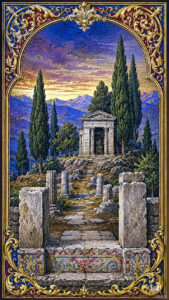
Her sanctuary at Tegea occupied sacred ground in the Late Bronze Age. Excavations have recovered Mycenaean material from the area. This is not a goddess invented in the Archaic period; rather, later Greeks inherited an already-ancient place of worship and the cult that inhabited it. The question is: what was that cult?
The name Alea is pre-Greek, likely belonging to an indigenous Arcadian goddess, not an epithet imported from elsewhere. Only later would she be associated with Athena, producing the compound Athena Alea (or, in the Doric form that would have been spoken in the Peloponnese, Athana Alea). This kind of religious fusion was common across the Greek world: a local goddess, the expansion of Panhellenic cult, identification rather than replacement. She was absorbed, and her name survived as a title.
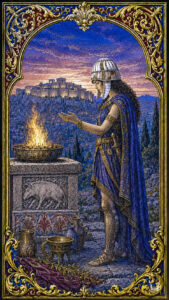 What sort of goddess Alea was before the merger is not known. Her mythology, if she had one independent of Athena, did not survive. Various proposals have been made—protectress of the community, mountain goddess, guardian of warriors—none demonstrable. What is evident is that the sanctuary became the most important religious center of Arcadia.
But Athena is neither an Archaic nor a Classical invention. A Linear B tablet from Knossos records a-ta-na po-ti-ni-ja: “Athana Potnia,” or “Mistress Athana.” The goddess bearing that name was worshipped in the Late Bronze Age. There are two ancient traditions converging: an existing Mycenaean Athena and an older Arcadian Alea whose cult occupied the Tegea sanctuary. By the historical period they had become inseparable.
For Atalanta of the Wild, I write of Athana Alea using the Doric form appropriate to an Arcadian setting in 1250 BCE. I do not import the later Athena wholesale: no birth from Zeus‘s head, no rivalry with Poseidon for Athens. What I preserve is the character of a goddess who guards a community, who is associated with craft and with warfare.
Alea and Pipituna also illustrate two different fates for Bronze Age religion after the collapse. Pipituna vanished almost entirely, surviving only in an accounting record. Alea endured by merging with a Panhellenic goddess. These are not mere footnotes; for a novelist, they are two distinct emotional registers. Pipituna’s silence is the silence of extinction. Alea’s endurance is the persistence of transformation. Both belong to the story of how the Bronze Age world became the world of historical Greece.
 IV. Potnia Theron: The Goddess Who Was Older Than Her Name
This goddess is the most ancient in kind, and the most difficult to write because her name is not Bronze Age at all.
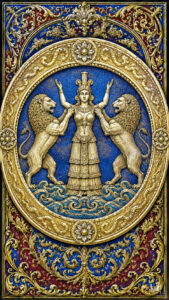
Potnia Theron means Mistress of Wild Animals. The phrase appears in Homer, where he calls Artemis πότνια θηρῶν in The Iliad, yet he uses it as an epithet, not naming a separate goddess. The phrase itself is Greek literature. The type it describes long predates it.
Long before Homer, Minoan artists were depicting a female figure standing between animals. The images recur across seal stones, frescoes, and gold rings: a goddess flanked by lions or griffins, deer or goats, often raising her arms and standing on a peak. This is the Mistress of Animals motif, found across the ancient Near East as well as the Aegean. It is an iconographic pattern, not a named individual, and it represents one of the most persistent religious ideas of antiquity: a sovereign female deity who rules the boundary between the human and the wild.
The Linear B tablets complicate this further. Po-ti-ni-ja, Potnia (“the Mistress”), appears throughout, both alone and with qualifying epithets such as Potnia of the Labyrinth, Potnia of grain, and many others. Potnia may have functioned as a divine title, applicable to several manifestations of a supreme deity rather than designating a single goddess.
 By name, however, Artemis is absent from Linear B. Unlike Athena, Poseidon, Zeus, Hermes, and Dionysus, she is not attested in the tablets. That is a difference that matters. Most historians say that a Bronze Age Mistress of Animals was later identified with Artemis, rather than that Artemis existed unchanged across the collapse. Her name and elaborate mythology crystallized over time; her image is ancient.
In Atalanta of the Wild, set in Mycenaean Arcadia around 1250 BCE, I use Potnia Theron, the Mistresse of Wild Things, as an epithet of the goddess, and I take the liberty of giving her the name Artemis while stripping her of everything that belongs to Classical literature. No Apollo‘s twin. No Orion. No Iphigenia at Aulis (but yes to a passing reference to Actaeon). What remains is something older: a guardian of animals, a presence who gives and withholds the hunt, who rules the forest and the pass and the high places where cultivated land gives way to wilderness.
Arcadian sanctuaries occupied ground that had been sacred since the Bronze Age. Several local forms of Artemis (Artemis Hymnia, Artemis Knakeatis) retain features inherited from earlier religious traditions. An Arcadian huntress goddess of the thirteenth century BCE would have resembled what Greeks recognized as Artemis, without sharing her later mythology.

That, in the end, is the essential truth this essay has been working toward. The Bronze Age did not produce the gods of Greece and hand them on intact. What emerged from it was a set of deep-rooted religious types—the maiden goddess, the oil goddess of the palace economy, the guardian of the ancient sanctuary, the sovereign of the wild—that endured into historical Greece by changing form, shedding old names and acquiring new ones, absorbing local cults, fragmenting, and merging.
The novelist who works in the Bronze Age is not writing about a proto-Olympian religion waiting for the advent of the eighth century BCE. He is writing about something earlier and stranger, a world of deities whose names we sometimes know and whose beliefs we can almost never recover, whose presence in the landscape was as real to the people who worshipped them as any god has ever been.
The silence is not an obstacle. It is the subject.
Rio de Janeiro, the xii day of July, MMXXVI.

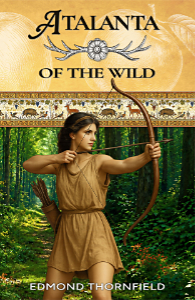
Click any cover to read a preview chapter and learn more.

Other essays in this ongoing series on the Bronze Age Aegean, the Homeric tradition, and the craft of writing historical fiction set in the ancient Eastern Mediterranean are available in the blog archive at ethornauthor.com.
Related essays include: